I have been working on a new novel for a couple of months now, and I've been attempting to write it without an outline, without any idea of where the story or the characters go. The idea is to discover all of this as I go along. It's an experiment in creativity, wherein I attempt to mimic the techniques of our own Davin Malasarn in the hopes that I'll stumble across the sort of surprising narrative turns that he has in his stories.
I really really (really) am hating it. In fact, I hate it so much that whenever I think about working on the story I get angry. I have no idea what it is so I have no idea what to do with it. In the last week or so, I have managed to write one sentence and it's not a particularly good sentence, either. I look at my notebook and my stack of reference materials and I think about all the other books I could be writing instead, the books where I have outlines and knowledge of the plot and the purpose of the characters. The books that I would enjoy writing.
Because I really really (really) am not enjoying the work on this current project. Yes, some of the bits are the best passages I've written, but I put that down to my having grown as a writer, not to my having no idea what I'm doing on the page. I don't see myself ever getting a finished novel-length draft out of this book, not writing it the way I am. There is nothing compelling me to move forward with the writing because I'm not going anywhere. I am not one of those people who can just go on a wander to see what I'll see; when I go for a walk, I like to know what the destination is and how long the walk will take and where I'll have a pint at the end of the walk. This wandering around through my manuscript is making me terribly nervy and that nervy quality is finding its way onto the page and I don't like that, either.
To make a long story short, I have decided that my plan to write this one without a plan is a bad sort of planless plan. I throw up my hands. I throw in the towel. I throw off the shackles of this prisonless prison, et cetera. Today I'm going to figure out what the hell the story is and what happens when my two main characters meet and how the book ends and why all of it takes place. So there. Otherwise I'm going to throw what I have of this book into the fireplace. Grrr. Argh.
Also, Happy New Year!

Showing posts with label Drafting Process/Revisions. Show all posts
Showing posts with label Drafting Process/Revisions. Show all posts
Tuesday, November 1, 2011

Wednesday, August 31, 2011
Three Acts, Two Acts or No Acts?
I've been thinking a lot about structure lately, about the large-scale organization of novels. I have two books in the works at present: one in rough-draft form that I'm about to start revising, and one just starting out with about 11,000 words written. The novel in draft form has a very loose 3-act structure, but only because I was pretending to follow the conventions of the genre (it's a literary detective novel).
There was a time that I leaned very hard on the 3-act structure. It's dependable, for one thing. It works. It gets the job done. There were a few years where, if I thought about the overall sweep of one of my books, I always imagined a three-part story. If I was putting together an outline of a book preparatory to writing a first draft, I'd spend hours tinkering with the plot and character arcs, working the whole thing up into the classic 3-act structure.
A couple of books ago I came up with a variation on the classic 3-act, which was the inner/outer conflict story model. Go here to read about it. That seems a pretty decent way of arranging a narrative, and it's also a sturdy, dependable model. You can write sturdy, dependable stories.
When I was drafting the detective story, I found that my writing was pushing against the 3-act structure. The whole "beginning-middle-ending" thing made sense at one level for what I was doing, but it made no sense at all for some of the other things I was working on. I ended up with a sort of hybrid structure, with a linear 3-act story going on while a bunch of short story type things kept cropping up along the way. Some of these short story things were flashbacks, some of them were almost self-contained stories and some of them were other things. Most of them dealt with the emotional themes of the story that weren't really addressed by the main detective story plot.
Working on the new book, I can see in my imagination how the first half of the book will go: two alternating stories that will join up in the middle of the book. And then, once the two main characters have met, some other stuff will happen. I have no idea what the "story question" is. I have no idea what will happen when my protagonists meet. I do know what each of them thinks they want more than anything else and I can see how their meeting will appear to open doors in their lives, but I don't know how any of that resolves. But I do know that this new novel doesn't fit into the 3-act structure. There isn't an "inciting incident" nor is there a development where the protagonist attempts to solve a problem, nor will there be a third act where the main conflict is resolved. Nope. None of that stuff. Two people move along, they meet, and stuff happens. I have a vague sense of how it will come out on the page, but I can't really see a big structure to it. And you know what? I'm not looking for one.
I think I'm now more interested in a more lifelike, realistic way of building narratives. The transformative hero's journey is wholly inadequate for the type of stories I'm trying to build these days. People->Action->Consequences, possibly, is the real paradigm. Don't talk to me of rising tension, I say.
One of the books I'm reading right now is Haruki Murakami's Wind-Up Bird Chronicles. Davin and I have been discussing it while I read it. He loved it and I've been having trouble with it. Today I read page 325 and there's a passage where one character tells the protagonist that he's not insignificant, that he's working on problems for any number of people without even knowing it. On the one hand, this passage bothers me because anyone who's read more than a couple of novels has already figured this out and this novel is thick with handholding statements like this, explaining itself to the reader in a clumsy sort of manner. On the other hand, I saw that Murakami really was presenting a Kafkaesque protagonist who was waffling around in a world that was largely incomprehensible to him (and to the reader) and that the point of the novel was that very incomprehensibility (which Davin told me last week but I didn't quite get it). The protagonist's world--and the narrative itself--are unpredictably shaped. Unexplained events and unlikely coincidences coexist in every chapter; who knows why? Just like reality. Now I'm enjoying the novel and I read a lot of it at lunch. I don't know if any of the story's questions will be answered, but I see that it doesn't matter if they do. What's the "meaning" of most of Kafka's stories? No idea and I don't care.
I'm also reading a lot of Chekhov stories, and Chekhov sort of invented the indeterminate ending, as well as the story where the climax comes at any point and the story might continue for thousands of words past that climax because the climax, the resolution of the primary tension, is not the real point of the stories. What's the organizing principle of a Chekhov story? That's hard to say, really. People. Action. Consequences. Or not.
Anyway, what I find most interesting about all of this is that, when I began writing novels, I struggled hard and long to find a structure around which to build stories. When I figured out how to use the classic 3-act structure, I was relieved and I thought I had that part of writing all figured out and I never had to think about structure again. After using the 3-act structure for a couple of novels, though, the artificiality of the form has made it more or less useless to me and I have to find something else. That "something else" seems at this point to be nothing more than a strong sense of what happens in life, a vague idea of causality, though I am working very hard to steal Davin Malasarn's trick of having unexpected changes of direction come along in the story.
So none of this is particularly useful or interesting, but it's what I've got. I thought I'd have something definite to say about large-scale structure, but it seems that all I've really got to say is that while I used to preach the classic 3-act shape, I no longer do. There are loads of excellent stories to be made using that structure (and almost every movie made follows it), but it's not a necessity. You can find your own way. Sometimes you have to.
There was a time that I leaned very hard on the 3-act structure. It's dependable, for one thing. It works. It gets the job done. There were a few years where, if I thought about the overall sweep of one of my books, I always imagined a three-part story. If I was putting together an outline of a book preparatory to writing a first draft, I'd spend hours tinkering with the plot and character arcs, working the whole thing up into the classic 3-act structure.
A couple of books ago I came up with a variation on the classic 3-act, which was the inner/outer conflict story model. Go here to read about it. That seems a pretty decent way of arranging a narrative, and it's also a sturdy, dependable model. You can write sturdy, dependable stories.
When I was drafting the detective story, I found that my writing was pushing against the 3-act structure. The whole "beginning-middle-ending" thing made sense at one level for what I was doing, but it made no sense at all for some of the other things I was working on. I ended up with a sort of hybrid structure, with a linear 3-act story going on while a bunch of short story type things kept cropping up along the way. Some of these short story things were flashbacks, some of them were almost self-contained stories and some of them were other things. Most of them dealt with the emotional themes of the story that weren't really addressed by the main detective story plot.
Working on the new book, I can see in my imagination how the first half of the book will go: two alternating stories that will join up in the middle of the book. And then, once the two main characters have met, some other stuff will happen. I have no idea what the "story question" is. I have no idea what will happen when my protagonists meet. I do know what each of them thinks they want more than anything else and I can see how their meeting will appear to open doors in their lives, but I don't know how any of that resolves. But I do know that this new novel doesn't fit into the 3-act structure. There isn't an "inciting incident" nor is there a development where the protagonist attempts to solve a problem, nor will there be a third act where the main conflict is resolved. Nope. None of that stuff. Two people move along, they meet, and stuff happens. I have a vague sense of how it will come out on the page, but I can't really see a big structure to it. And you know what? I'm not looking for one.
I think I'm now more interested in a more lifelike, realistic way of building narratives. The transformative hero's journey is wholly inadequate for the type of stories I'm trying to build these days. People->Action->Consequences, possibly, is the real paradigm. Don't talk to me of rising tension, I say.
One of the books I'm reading right now is Haruki Murakami's Wind-Up Bird Chronicles. Davin and I have been discussing it while I read it. He loved it and I've been having trouble with it. Today I read page 325 and there's a passage where one character tells the protagonist that he's not insignificant, that he's working on problems for any number of people without even knowing it. On the one hand, this passage bothers me because anyone who's read more than a couple of novels has already figured this out and this novel is thick with handholding statements like this, explaining itself to the reader in a clumsy sort of manner. On the other hand, I saw that Murakami really was presenting a Kafkaesque protagonist who was waffling around in a world that was largely incomprehensible to him (and to the reader) and that the point of the novel was that very incomprehensibility (which Davin told me last week but I didn't quite get it). The protagonist's world--and the narrative itself--are unpredictably shaped. Unexplained events and unlikely coincidences coexist in every chapter; who knows why? Just like reality. Now I'm enjoying the novel and I read a lot of it at lunch. I don't know if any of the story's questions will be answered, but I see that it doesn't matter if they do. What's the "meaning" of most of Kafka's stories? No idea and I don't care.
I'm also reading a lot of Chekhov stories, and Chekhov sort of invented the indeterminate ending, as well as the story where the climax comes at any point and the story might continue for thousands of words past that climax because the climax, the resolution of the primary tension, is not the real point of the stories. What's the organizing principle of a Chekhov story? That's hard to say, really. People. Action. Consequences. Or not.
Anyway, what I find most interesting about all of this is that, when I began writing novels, I struggled hard and long to find a structure around which to build stories. When I figured out how to use the classic 3-act structure, I was relieved and I thought I had that part of writing all figured out and I never had to think about structure again. After using the 3-act structure for a couple of novels, though, the artificiality of the form has made it more or less useless to me and I have to find something else. That "something else" seems at this point to be nothing more than a strong sense of what happens in life, a vague idea of causality, though I am working very hard to steal Davin Malasarn's trick of having unexpected changes of direction come along in the story.
So none of this is particularly useful or interesting, but it's what I've got. I thought I'd have something definite to say about large-scale structure, but it seems that all I've really got to say is that while I used to preach the classic 3-act shape, I no longer do. There are loads of excellent stories to be made using that structure (and almost every movie made follows it), but it's not a necessity. You can find your own way. Sometimes you have to.
Monday, August 22, 2011
Hello Pansters, You Are All Mad Aren't You?
So I am working on a new novel right now, and I've allowed myself to be led astray by the methods of Davin Malasarn, who writes without an outline. This is my sixth novel. Way back in 1990 I started my first novel (which I like to call The Precious Unpublishable Mess) and spent a few years writing the first half of the story, working without an outline. One night I sat down and wrote out a detailed outline of the second half of the story and finished the book up within a few months. Huh, I said. Things went a lot more quickly with an outline than without one. After that, I wrote four more novels.
Each of those four books was planned in advance, at least in broad strokes: I knew what the big conflicts were, I knew how the stories ended, I knew who all the main characters were and how they related to the conflicts. As I wrote the first drafts, I was able to see how my subconscious was feeding me images that tied into the central conflicts/themes of the book and I was able to craft large-scale symbolic systems that tie the whole story together. Most importantly, I knew what the hell I was doing with each scene I wrote. I could see how what I was building all worked toward the vision I had of the novel.
Now, of course, I've got none of that. I'm sort of hurling words at the page and seeing what shapes they form, like some sort of Rorschach test or something. Really, it's entirely maddening. I have a bunch of characters and I see how they all fit together, sort of, but I don't really know what they'll do. I have two main storylines, but I don't know what the stories are. No, don't even ask how that's possible. The storylines might intersect at some point or they might not. I'll know if/when I get there.
Certain images are occurring to me so I write them down but I don't know if they matter to the themes or story because I don't know the themes or story. I just keep writing forward into the breach with no idea at all what's waiting for me in that breach, and I'll put down 1,000 words and then see that they don't actually follow what I've got but then I see that if I slip an additional 1,000 words between the extant prose and the new passages, it'll all fit together and there's a sense of forward motion but to what? I don't know. I don't know. I don't know.
It sets my teeth on edge. There are people who write like this all the time, who would rather write like this than know where they're going. I find myself getting upset and while I've managed to keep pressing on at the usual rate (the biggest surprise to me has been that I don't write more slowly without an outline than with one), I feel dizzy often when I consider the story, because it's like squinting to look at something that's invisible. Maddening, it is. Insanity.
You pansters, I say, are certainly making life hard on yourselves.
And yet, I am conducting this experiment because I believe in my heart of hearts that there are valuable lessons to be learned about writing with this method. I'm traveling through an unknown landscape with no map, no compass and no idea who or what or where I'll see along the way. I could argue that there's a sort of purity to this method, that I won't be hampered by any preconceived notions about the structure of a story. Certainly I'm not writing to the three-act paradigm right now. I can make a long list of what I'm not doing; what's harder is saying what I am. I have no idea. It makes me tense. Yet it's interesting, and that's enough. Also, the writing is really good. Some of my most gorgeous bits ever. So while there's a madness to this method, I keep at it.
Each of those four books was planned in advance, at least in broad strokes: I knew what the big conflicts were, I knew how the stories ended, I knew who all the main characters were and how they related to the conflicts. As I wrote the first drafts, I was able to see how my subconscious was feeding me images that tied into the central conflicts/themes of the book and I was able to craft large-scale symbolic systems that tie the whole story together. Most importantly, I knew what the hell I was doing with each scene I wrote. I could see how what I was building all worked toward the vision I had of the novel.
Now, of course, I've got none of that. I'm sort of hurling words at the page and seeing what shapes they form, like some sort of Rorschach test or something. Really, it's entirely maddening. I have a bunch of characters and I see how they all fit together, sort of, but I don't really know what they'll do. I have two main storylines, but I don't know what the stories are. No, don't even ask how that's possible. The storylines might intersect at some point or they might not. I'll know if/when I get there.
Certain images are occurring to me so I write them down but I don't know if they matter to the themes or story because I don't know the themes or story. I just keep writing forward into the breach with no idea at all what's waiting for me in that breach, and I'll put down 1,000 words and then see that they don't actually follow what I've got but then I see that if I slip an additional 1,000 words between the extant prose and the new passages, it'll all fit together and there's a sense of forward motion but to what? I don't know. I don't know. I don't know.
It sets my teeth on edge. There are people who write like this all the time, who would rather write like this than know where they're going. I find myself getting upset and while I've managed to keep pressing on at the usual rate (the biggest surprise to me has been that I don't write more slowly without an outline than with one), I feel dizzy often when I consider the story, because it's like squinting to look at something that's invisible. Maddening, it is. Insanity.
You pansters, I say, are certainly making life hard on yourselves.
And yet, I am conducting this experiment because I believe in my heart of hearts that there are valuable lessons to be learned about writing with this method. I'm traveling through an unknown landscape with no map, no compass and no idea who or what or where I'll see along the way. I could argue that there's a sort of purity to this method, that I won't be hampered by any preconceived notions about the structure of a story. Certainly I'm not writing to the three-act paradigm right now. I can make a long list of what I'm not doing; what's harder is saying what I am. I have no idea. It makes me tense. Yet it's interesting, and that's enough. Also, the writing is really good. Some of my most gorgeous bits ever. So while there's a madness to this method, I keep at it.
Tuesday, April 5, 2011
At Sixes and Sevens (or, Accepting Bad Writing)
I've begun work on a new book while my lovely and charming agent shops my novels around. I'm told that this will keep the insanity away. Also, I'm a writer, or so I tell people, and that means I should be writing. So I am. Writing, that is. Or at least that's what I pretend to be doing.
In truth, I started the new book about two weeks ago and have made very little progress with the narrative. I've made any number of outlines and drafted notes to myself about scenes in the middle of the book and have read some of my research materials but as to actual writing as in putting words on the page? Not so much. Oh, a few thousand words, maybe even the first half of Chapter One. But mostly I've been stalling and decidedly not writing.
Why? It occured to me today that the first chapter of this book is a bit of a mess. It's going to need some work when I get around to revisions and it's just rougher than I like my writing to be, so I've sort of been avoiding it because I have my standards, you know, and I'm not living up to them with this draft, or what I've got of a draft just now.
My choices are to either write miraculously shining prose on the first go-round or to just put my head down and write badly, just to get the shape of the story on the page and have something written that I can revise. My belief is that most of the art actually happens in the revisions and not in the drafting anyway, not that I really see a lot of difference between writing and rewriting but that's a different topic.
No, I need to just accept that this first chapter--maybe even the first couple of chapters of the new book--are going to be a lot of bad writing, and just get on with my bad writing so that possibly I can eventually get to the good writing.
Which gets to the real issue: I took some time off after my last book and got out of the habit of writing prose almost every day. Now my normal routine doesn't make any room for regular prose writing and I have to change things around to accommodate it again. The first thing that has to happen is to get excited (or at least grudgingly willing) to commit to the sustained effort it will take to write a book-length story. For me, this has always meant just being hard enough on myself that I start in on it and accept that, for the next six months, I'll give over my lunches and evening commutes to the new book, and I won't be reading much or thinking about much except the novel. Basically I engage in psychic arm-twisting.
I know that a lot of people start new projects while the idea is fresh and magical and use the energy gained from learning about the ideas while writing them out as a way to get hooked into the effort. But for those of us who do a lot of pre-production work, outlining and research, that is, it might sometimes be harder to get the ball rolling and gather the necessary momentum to jump in and get a good start on a new project. I'd be interested to hear from that group, the planners and outliners, about how it goes with you when you start in on the actual writing of a new project. Does it seem like a big effort is required? Do you drag your feet before starting in earnest? Or do you just happily jump in and start racking up words?
In truth, I started the new book about two weeks ago and have made very little progress with the narrative. I've made any number of outlines and drafted notes to myself about scenes in the middle of the book and have read some of my research materials but as to actual writing as in putting words on the page? Not so much. Oh, a few thousand words, maybe even the first half of Chapter One. But mostly I've been stalling and decidedly not writing.
Why? It occured to me today that the first chapter of this book is a bit of a mess. It's going to need some work when I get around to revisions and it's just rougher than I like my writing to be, so I've sort of been avoiding it because I have my standards, you know, and I'm not living up to them with this draft, or what I've got of a draft just now.
My choices are to either write miraculously shining prose on the first go-round or to just put my head down and write badly, just to get the shape of the story on the page and have something written that I can revise. My belief is that most of the art actually happens in the revisions and not in the drafting anyway, not that I really see a lot of difference between writing and rewriting but that's a different topic.
No, I need to just accept that this first chapter--maybe even the first couple of chapters of the new book--are going to be a lot of bad writing, and just get on with my bad writing so that possibly I can eventually get to the good writing.
Which gets to the real issue: I took some time off after my last book and got out of the habit of writing prose almost every day. Now my normal routine doesn't make any room for regular prose writing and I have to change things around to accommodate it again. The first thing that has to happen is to get excited (or at least grudgingly willing) to commit to the sustained effort it will take to write a book-length story. For me, this has always meant just being hard enough on myself that I start in on it and accept that, for the next six months, I'll give over my lunches and evening commutes to the new book, and I won't be reading much or thinking about much except the novel. Basically I engage in psychic arm-twisting.
I know that a lot of people start new projects while the idea is fresh and magical and use the energy gained from learning about the ideas while writing them out as a way to get hooked into the effort. But for those of us who do a lot of pre-production work, outlining and research, that is, it might sometimes be harder to get the ball rolling and gather the necessary momentum to jump in and get a good start on a new project. I'd be interested to hear from that group, the planners and outliners, about how it goes with you when you start in on the actual writing of a new project. Does it seem like a big effort is required? Do you drag your feet before starting in earnest? Or do you just happily jump in and start racking up words?
Thursday, January 27, 2011
This is When Writing Gets Private
Would you believe me if I said it has taken me 15 years to figure out a problem in one of my novels? Maybe that means I'm really slow, but all it really means is that I had a lot to learn about writing before I could write the story the way it needs to be written.
I've rewritten this particular book probably 20 times now. I don't mean dinky, fluffy little revisions. I mean MAJOR REWRITES, probably half of those starting the document from scratch with a blank slate.
This book makes me feel stupid when I look at the stats.
These numbers aren't anything private. They are the things I can share and laugh about. People, writers and readers alike understand these facts for the most part. So where does writing get private? As I was working on the book a few days ago, something clicked. I don't mean a small click. It was a huge, monstrous, earth-shattering CLICK!!!!!!!!!!
I almost stopped breathing.
I finally knew how to make the book work. I saw what had been wrong with it for so long. It's something I'd love to share, but honestly, it wouldn't make sense to anyone but me. It's strange. A part of me wants to try and explain what has happened, but it would only come out as a very long, dry, and confusing post. I finally have instincts to guide my way through writing. I've spent a long time building these instincts, and there is no way to share them with anyone. It's sad and depressing and selfish all at the same time, but a part of me doesn't care. That part of me is jumping up and down with excitement that I can finally make this book work.
I think every writer needs privacy surrounding the way they write. It's great to share some of the knowledge we have, but much of the magic which happens during the writing process can't be explained or shared. I think that's how it should be. Sometimes I read posts about rules and processes and I get so overwhelmed with all the noise. It's good to learn these things and understand them, but the only thing that's going to make your writing truly amazing is to find the place where you forget everything else and trust yourself. Nobody can tell you how to do that but you.
I've rewritten this particular book probably 20 times now. I don't mean dinky, fluffy little revisions. I mean MAJOR REWRITES, probably half of those starting the document from scratch with a blank slate.
This book makes me feel stupid when I look at the stats.
People who have read a draft of the book at one time or another
estimated 50 people (Can you believe that? Yeah, neither can I, but it's sadly true. Some of those 50 people have read the book multiple times.)Years I've worked on the book
15 (You'd think it would be really, really, really good, huh? Yeah, it's not. Yet.)Number of rewrites
20Number of places I've lived while working on this book
4Number of times I've queried the book
2 (This was a brief moment of insanity, and then I realized how far off the book was from being ready. These are the only official queries I've ever sent out for anything I've written.)The book's first word count
37,750 (I first wrote the book by hand because when I started it, I didn't even know what a word processor was.)These numbers aren't anything private. They are the things I can share and laugh about. People, writers and readers alike understand these facts for the most part. So where does writing get private? As I was working on the book a few days ago, something clicked. I don't mean a small click. It was a huge, monstrous, earth-shattering CLICK!!!!!!!!!!
I almost stopped breathing.
I finally knew how to make the book work. I saw what had been wrong with it for so long. It's something I'd love to share, but honestly, it wouldn't make sense to anyone but me. It's strange. A part of me wants to try and explain what has happened, but it would only come out as a very long, dry, and confusing post. I finally have instincts to guide my way through writing. I've spent a long time building these instincts, and there is no way to share them with anyone. It's sad and depressing and selfish all at the same time, but a part of me doesn't care. That part of me is jumping up and down with excitement that I can finally make this book work.
I think every writer needs privacy surrounding the way they write. It's great to share some of the knowledge we have, but much of the magic which happens during the writing process can't be explained or shared. I think that's how it should be. Sometimes I read posts about rules and processes and I get so overwhelmed with all the noise. It's good to learn these things and understand them, but the only thing that's going to make your writing truly amazing is to find the place where you forget everything else and trust yourself. Nobody can tell you how to do that but you.
Tuesday, January 4, 2011
How Long Does It Take?
I am currently revising the first draft of my novel Cocke & Bull. I finished writing this first draft about ten months ago and until mid-December 2010 I ignored it to work on other projects. I would like to get through revisions pretty quickly so that I can turn to yet another project, because I dream of a future in which I produce a publication-ready novel about once a year.
That might be impossible, though. I've been trying to figure out how long I'll need to write a book, and of course the answer is going to be that "it depends on the book."
My first novel, which we'll call The Unpublishable Mess, took about five years to write. That was just a first draft. My next novel, Killing Hamlet, took about three years to get from "raw idea" to "on submission." I wrote the first draft of Cocke & Bull in about five months and I'd like to think that I can get it properly rewritten and ready for submission in fewer than seven months, which means that--were I not interrupted by other projects--it is theoretically possible for me to write and revise a novel in a year.
Which idea pleases the organized Virgo part of my mind, because the timeline is neat and tidy and possibly could lead to a dependable income stream at some future point in time. But the idea troubles the disorganized Artist part of my mind, especially when I consider that many of my favorite authors take years to write a book, and that many of my favorite books took forever to write. I wonder, you know, if I'm not being careful enough with my stories, if I'm not considering them long enough, not putting enough work into them, not bringing the goods, as it were.
The thing is, I write pretty quickly. Either I have an idea for a novel that I can write or I don't; if I do, I write it down and if I don't, I go watch BTVS on DVD or whatever until I think up a different book to write. While I am certainly in a white-hot fever during the actual writing, I don't feel like I'm rushing the work. It takes as long as it takes, but no longer. I have friends who have labored for years over novels, while over lunch today I wrote a new scene to insert into my WIP, spending no more than 15 minutes on it. Maybe I'll rewrite the scene, and maybe I won't; it feels pretty solid to me.
So where I'm going with all of this is to ask you, Mighty Writers, how long you spend on your novels. I'm looking to see what sort of data point spread there is so I can plot my own progress versus the statistical mean. Or something. Anyway, how long does it take you to write/revise a book? If you've been published (Alex), that's an additional helpful bit of info.
That might be impossible, though. I've been trying to figure out how long I'll need to write a book, and of course the answer is going to be that "it depends on the book."
My first novel, which we'll call The Unpublishable Mess, took about five years to write. That was just a first draft. My next novel, Killing Hamlet, took about three years to get from "raw idea" to "on submission." I wrote the first draft of Cocke & Bull in about five months and I'd like to think that I can get it properly rewritten and ready for submission in fewer than seven months, which means that--were I not interrupted by other projects--it is theoretically possible for me to write and revise a novel in a year.
Which idea pleases the organized Virgo part of my mind, because the timeline is neat and tidy and possibly could lead to a dependable income stream at some future point in time. But the idea troubles the disorganized Artist part of my mind, especially when I consider that many of my favorite authors take years to write a book, and that many of my favorite books took forever to write. I wonder, you know, if I'm not being careful enough with my stories, if I'm not considering them long enough, not putting enough work into them, not bringing the goods, as it were.
The thing is, I write pretty quickly. Either I have an idea for a novel that I can write or I don't; if I do, I write it down and if I don't, I go watch BTVS on DVD or whatever until I think up a different book to write. While I am certainly in a white-hot fever during the actual writing, I don't feel like I'm rushing the work. It takes as long as it takes, but no longer. I have friends who have labored for years over novels, while over lunch today I wrote a new scene to insert into my WIP, spending no more than 15 minutes on it. Maybe I'll rewrite the scene, and maybe I won't; it feels pretty solid to me.
So where I'm going with all of this is to ask you, Mighty Writers, how long you spend on your novels. I'm looking to see what sort of data point spread there is so I can plot my own progress versus the statistical mean. Or something. Anyway, how long does it take you to write/revise a book? If you've been published (Alex), that's an additional helpful bit of info.
Thursday, December 16, 2010
Is Your Work Supremely Boring?

Last week I posted the question if your first chapter can be too exciting. Today I'd like to ask if your work is supremely boring. My greatest fear is that my stories are soooooboooooorrrrring. I go through this on every draft because after awhile they are so familiar to me I can't imagine anyone else would find them exciting. This is why I have what I call Alpha Readers - more like Cheerleaders. They are made of awesome. They deserve a special place in heaven.
A long time ago I would have said that if a writer got to the point where their work was boring to them, they were in big trouble. I don't believe that now. Some writers spend years on a project. It can get so familiar that working on it can be boring and, well, a lot of work. However, these writers who become bored with their work still love their work, and they are still driven by artistic achievement. That's not boring.
I think that's the word to remember: familiar.
Anytime something becomes familiar, it runs the risk of becoming boring. If this happens to you and your book, keep going. Most writers I know who have this problem start working on another project. I suppose that's one way around the problem, but it can create other, bigger, problems. As I said above, a good way around all this is to get some good Alpha Readers (readers who read as you write, chapter by chapter or section by section). Cheerleaders are important, at least for me. I can't write in a vacuum. Talk about becoming too familiar with my surroundings...
My answers aren't the answers for everyone. How do you deal with getting bored with your work?
_____________________________
On another note, we received all but one entry for our Notes from Underground anthology! For the next month we'll be formatting this huge project and getting it ready for sale. We'll unveil the cover as soon as we can. Special thanks to Tara Maya for her artistic talents!
Tuesday, December 7, 2010
In Praise of Ambiguity
One of the things I have come to believe is that stories which can't easily be summed up, whose themes are complicated or ambiguous, whose characters are neither good nor bad nor indifferent, are the stories that stay with us the longest and have the most power with readers. Stories that reduce life to simple, easily-digested and easily-described forces tend to be forgettable and aren't the stories that readers come back to or put into the hands of other readers. But stories that mirror the real complexity of the world sometimes take on lives of their own and work their way into the fabric of our culture. Myths do this, and if you look at myths you will see that they are generally messy and morally indeterminate. The plays (especially the tragedies) of Shakespeare do this, with their unexplained bursts of violence and their protagonists who are both hero and devil.
Where, you might ask, is all of this coming from? Well, I am writing a synopsis of my novel Cocke & Bull. I've never had the scintillating pleasure of crafting a synopsis before, but I figured it couldn't be that hard. After all, I know the story pretty well and I have my outline so how difficult can it be to flesh out my notes into a one-page narrative of the narrative?
It turned out to be harder than it looked, because while the story is fairly straightforward and the character arcs are easy enough to describe, the meaning of the dramatic action is ambiguous. Why do my characters do the things they do? Well, it's complicated. How do my characters feel about each other and themselves? Well, it's not really clear and it depends, you know, it really depends. The more I narrow the focus of the discussion about the story, the less powerful the story seems.
You know how, when you're in grammar school English classes (and sometimes when you're in university-level English courses), the teacher tries to get you to come up with a one-sentence statement of a story's themes? I don't care what your one sentence is; any decent story is going to be poorly-described by it. With a good teacher, those "theme sentences" might lead to a smart discussion of the story, but the discussion of stories shouldn't lead to those reductionist one-sentence statements. Because a good story is rich and has multiple layers that cannot easily be described. A good writer examines her topics from many angles and shows those angles to the reader but never sums up or chooses which angle is best, especially which ethical or moral angle. A good writer sympathizes with his characters but doesn't shy away from showing when those characters do unsympathetic things.
A good story is not simple.
When I revise, there is a temptation to cut out anything that adds ambiguity to the story. There is a temptation to eliminate multiple meanings, to narrow, to remove vagueness, to cast everything as either/or and to make the actions, characters and themes easy to grasp. This is a temptation that I must resist, because if I give in to that temptation, the story will be emptied out, and much smaller than life. I don't mind writing a story that can't really be figured out once and for all. The truth, at least as I see it, is that life is difficult and messy and not readily summed up. I want my fiction to be the same way.
Which means that my synopsis will of necessity be a sort of one-dimensional discussion of my novel, but that's okay as long as I don't start thinking that the book should be as easy to grasp as the synopsis.
Where, you might ask, is all of this coming from? Well, I am writing a synopsis of my novel Cocke & Bull. I've never had the scintillating pleasure of crafting a synopsis before, but I figured it couldn't be that hard. After all, I know the story pretty well and I have my outline so how difficult can it be to flesh out my notes into a one-page narrative of the narrative?
It turned out to be harder than it looked, because while the story is fairly straightforward and the character arcs are easy enough to describe, the meaning of the dramatic action is ambiguous. Why do my characters do the things they do? Well, it's complicated. How do my characters feel about each other and themselves? Well, it's not really clear and it depends, you know, it really depends. The more I narrow the focus of the discussion about the story, the less powerful the story seems.
You know how, when you're in grammar school English classes (and sometimes when you're in university-level English courses), the teacher tries to get you to come up with a one-sentence statement of a story's themes? I don't care what your one sentence is; any decent story is going to be poorly-described by it. With a good teacher, those "theme sentences" might lead to a smart discussion of the story, but the discussion of stories shouldn't lead to those reductionist one-sentence statements. Because a good story is rich and has multiple layers that cannot easily be described. A good writer examines her topics from many angles and shows those angles to the reader but never sums up or chooses which angle is best, especially which ethical or moral angle. A good writer sympathizes with his characters but doesn't shy away from showing when those characters do unsympathetic things.
A good story is not simple.
When I revise, there is a temptation to cut out anything that adds ambiguity to the story. There is a temptation to eliminate multiple meanings, to narrow, to remove vagueness, to cast everything as either/or and to make the actions, characters and themes easy to grasp. This is a temptation that I must resist, because if I give in to that temptation, the story will be emptied out, and much smaller than life. I don't mind writing a story that can't really be figured out once and for all. The truth, at least as I see it, is that life is difficult and messy and not readily summed up. I want my fiction to be the same way.
Which means that my synopsis will of necessity be a sort of one-dimensional discussion of my novel, but that's okay as long as I don't start thinking that the book should be as easy to grasp as the synopsis.
Monday, December 6, 2010
Story is a matter of organization
A couple of days ago, I was responsible for teaching a lesson on "Genomic Approaches to Multifactorial Disease" to a class of college juniors. It was a topic that I knew very little about, considering my thesis was about arsenic contamination in Bangladesh.
As the cherry on top, none of my co-workers in lab really knew much about "Genomic Approaches to Multifactorial Disease" either--and they all happened to be very busy last week, so they probably couldn't have helped me even if they did--so I ended up giving a practice lesson to my friend T, who is a fellow writer, not a scientist.
So, there T and I are, practicing in my office, and I'm throwing out scientific terms and diagrams and methods of statistical analysis, when he raises his hand and says, "I think you should show and not tell."
It took me a second to understand where he was going with this, but then I figured it out.
See, I had been giving a general outline of genomic approaches to multifactorial diseases to him without getting to an actual example, like the study of high blood pressure, and he said that, for him, the example would make everything clearer.
The whole experience reminded me that almost every message we communicate to someone else can be organized in the form of a story...and techniques that we use to tell an exciting story can also be applied to any messages to make them more exciting.
When the time came for me to give my actual lesson, I organized each part of my lecture to come out like a story, setting up a question in the beginning, going through the thought process of how to solve that question, and then building to the climax where the question was answered. It made for an engaging discussion, and I had multiple students come up to me after the lecture to say how interesting my talk was.
This has all reminded me that the skills we learn as story tellers can be applied to so many things outside of our fiction writing. I think I seem to be a more interesting person in general because I've learned to share details about my life more in a story form. It's a matter of organization, setting things up so that there's a beginning, middle, and end. It's a nice tool to carry in our back pocket for anytime we need it.
And! It's December 6, just a few days before all of our Notes From Underground stories are due! I'm excited to see what we end up with. Already, we've gotten some great stories, and I can't wait to get them published and available for readers!
Wednesday, December 1, 2010
Stick with your ideas?
Sorry, everyone...I completely forgot that I was supposed to do a post today. The truth is, I've been swamped all week with work. But, I wish everyone happy writing!
I've been working on a new story, and I hope it engages me enough so that I can see it through. I've been trying my best to keep it under wraps, though I've spilled the beans to a couple of you. It involves the Dalai Lama! He gets hooked up to a machine and becomes semi-robotic! That's all I'll say and nothing more.
Michelle brought up the other day that she was surprised by how often I start ideas and don't finish them. The reason I do that is because each new story is an experiment for me. I don't know if it will go anywhere, and most of them don't, even though the beginning might be interesting. I tend to start multiple things and then stick with the one that compels me the most.
Does anyone else work the same way or do you find one good idea and stick with it?
Wednesday, November 24, 2010
Houellebecq And I Research The Same Way
I am currently reading Michel Houellebecq's Atomised, which I will tell you reminds me of Antonia Byatt's Babel Tower series crossed with, maybe, Gunter Grass's Local Anaesthetic. Possibly the similarities I see are only superficial: something about the way Grass shows the inner life of his protagonist, and Byatt's interest in and use of biosciences and the way she'll slip long passages about the biology of snails (for example) into her narratives. Other readers will of course make connections between Atomised and authors other than Byatt and Grass, and it would be easy for me to sort of digress into a discussion of how what we've already read informs what we are currently reading, but I'll leave that for the literary theorists who believe in reader-response theory (take it away, boys...).
Where? Oh, Houellebecq. So I'm reading this book and you can see that the author has done a lot of research, on biology and physics, on the history of science and scientific writing, on the life of Aldous Huxley and his family, on the sociopolitical changes in Europe during the 60s and 70s, et cetera. Houellebecq takes on some pretty big themes here and has clearly spent a lot of time reading and thinking about these things.
But I wonder if that's how he began this book. At the heart of the novel is the story of two half brothers, Michel and Bruno, who are externally very different but deep down very much the same. Each of them is an aspect of a sort of 20th-century Everyman living in an "atomised" or isolated society, looking for love but unable to go about it in anything but destructive, meaningless ways. I think that Houellebecq began with these two brothers (one an artist, one a brilliant scientist), started to research and stumbled across the larger ideas he's incorporated into the novel. I get the feeling that he, like Antonia Byatt, lets his reading take him where it will, and he reads to find out, to see what he can see, to learn what's there to be learned and to be able to write what he doesn't know, because writing about what we don't know is always more interesting than writing about what we do know.
Now, it's entirely possible that I assume this about Houellebecq because that's how I go about my own research for novels, and I like to generalize from my own behavior because I've got this massive ego and so everyone must be, at root, just like me because I am the very measure of normality. Likely I'm wrong, and not just about the way some French guy researched a book in the late 1990s.
But, as I say, that's how I research: I begin with vague ideas for my characters and then I try to learn about what sort of daily lives they'd have. That reading always leads down surprising paths and ideas begin to present themselves for inclusion in the book. For example, I am currently researching stuff for my next project, Nowhere But North. This book is the story of an expedition to Antarctica in 1914, based very loosely on the expedition of that year by Ernest Shackleton aboard the HMS Endurance. So I've got a stack of books about that expedition because I want to know what it's like to live on a sailing ship that's trapped in the ice off the Antarctic coast in 1914-15. I also want to know about the expedition leader, because my book has an expedition leader (who is only partially modeled on Shackleton).
I have three other main characters: my protagonist (who is the quartermaster of the expedition, and works in an office at New York Harbor before he joins the ship's crew); Lilly, the expedition leader's daughter (Lilly is bright, educated and in love with the protagonist); and a guy named Fitzgerald (I think) who is the second-in-command on the expedition. Fitzgerald is the villain in the piece.
So I am reading books about New York City in 1900-1914 because 1/3 of the narrative takes place there. I am reading about Greenwich Village in 1914 because that's where my protagonist lives. I picked The Village because I've been there, and because I stumbled across some interesting books about it when I was shopping for books about old New York. Reading about Greenwich Village in that period led me to a bunch of women activists of the era which has told me a lot about who Lilly is, and has given me an idea for one of the big themes of the book: the social activism of women in 1914 versus the self-aggrandizing vainglory of men at the end of the Age of Exploration. That theme found me, as did a bunch of other stuff I'll work into the book.
And I'm nowhere near done with my research yet, and I have no idea what other ideas are sitting around out there waiting for me to see them and decide they'll work in this narrative.
My book Killing Hamlet prominently features the astrologer Tycho Brahe because it occurred to me one day that Brahe died the same year Shakespeare wrote "Hamlet" and I thought I could connect them. It was never a part of my original idea. My book Cocke & Bull has a hurricane because I was researching Norfolk, VA and I stumbled upon the fact that the big sand bar at the mouth of the river was dredged up by a hurricane in October of 1749, so I shifted a few things around so that I could use the hurricane and the date because a hurricane is a really cool thing to have in Act Three of your novel. The second half of the book's middle is set in the Great Dismal Swamp along the Virginia/North Carolina border because I saw the name on a map and who can resist that? As I say, I sort of let my research treat me like the ball in a pinball machine: I go where it sends me and I stay open to whatever cool ideas I'm knocked against.
So now to you: what's a surprising thing you stumbled upon that you've used in a book/story, something that was not part of the original idea but pushed the story into a cool new place you never would have thought of on your own?
Where? Oh, Houellebecq. So I'm reading this book and you can see that the author has done a lot of research, on biology and physics, on the history of science and scientific writing, on the life of Aldous Huxley and his family, on the sociopolitical changes in Europe during the 60s and 70s, et cetera. Houellebecq takes on some pretty big themes here and has clearly spent a lot of time reading and thinking about these things.
But I wonder if that's how he began this book. At the heart of the novel is the story of two half brothers, Michel and Bruno, who are externally very different but deep down very much the same. Each of them is an aspect of a sort of 20th-century Everyman living in an "atomised" or isolated society, looking for love but unable to go about it in anything but destructive, meaningless ways. I think that Houellebecq began with these two brothers (one an artist, one a brilliant scientist), started to research and stumbled across the larger ideas he's incorporated into the novel. I get the feeling that he, like Antonia Byatt, lets his reading take him where it will, and he reads to find out, to see what he can see, to learn what's there to be learned and to be able to write what he doesn't know, because writing about what we don't know is always more interesting than writing about what we do know.
Now, it's entirely possible that I assume this about Houellebecq because that's how I go about my own research for novels, and I like to generalize from my own behavior because I've got this massive ego and so everyone must be, at root, just like me because I am the very measure of normality. Likely I'm wrong, and not just about the way some French guy researched a book in the late 1990s.
But, as I say, that's how I research: I begin with vague ideas for my characters and then I try to learn about what sort of daily lives they'd have. That reading always leads down surprising paths and ideas begin to present themselves for inclusion in the book. For example, I am currently researching stuff for my next project, Nowhere But North. This book is the story of an expedition to Antarctica in 1914, based very loosely on the expedition of that year by Ernest Shackleton aboard the HMS Endurance. So I've got a stack of books about that expedition because I want to know what it's like to live on a sailing ship that's trapped in the ice off the Antarctic coast in 1914-15. I also want to know about the expedition leader, because my book has an expedition leader (who is only partially modeled on Shackleton).
I have three other main characters: my protagonist (who is the quartermaster of the expedition, and works in an office at New York Harbor before he joins the ship's crew); Lilly, the expedition leader's daughter (Lilly is bright, educated and in love with the protagonist); and a guy named Fitzgerald (I think) who is the second-in-command on the expedition. Fitzgerald is the villain in the piece.
So I am reading books about New York City in 1900-1914 because 1/3 of the narrative takes place there. I am reading about Greenwich Village in 1914 because that's where my protagonist lives. I picked The Village because I've been there, and because I stumbled across some interesting books about it when I was shopping for books about old New York. Reading about Greenwich Village in that period led me to a bunch of women activists of the era which has told me a lot about who Lilly is, and has given me an idea for one of the big themes of the book: the social activism of women in 1914 versus the self-aggrandizing vainglory of men at the end of the Age of Exploration. That theme found me, as did a bunch of other stuff I'll work into the book.
And I'm nowhere near done with my research yet, and I have no idea what other ideas are sitting around out there waiting for me to see them and decide they'll work in this narrative.
My book Killing Hamlet prominently features the astrologer Tycho Brahe because it occurred to me one day that Brahe died the same year Shakespeare wrote "Hamlet" and I thought I could connect them. It was never a part of my original idea. My book Cocke & Bull has a hurricane because I was researching Norfolk, VA and I stumbled upon the fact that the big sand bar at the mouth of the river was dredged up by a hurricane in October of 1749, so I shifted a few things around so that I could use the hurricane and the date because a hurricane is a really cool thing to have in Act Three of your novel. The second half of the book's middle is set in the Great Dismal Swamp along the Virginia/North Carolina border because I saw the name on a map and who can resist that? As I say, I sort of let my research treat me like the ball in a pinball machine: I go where it sends me and I stay open to whatever cool ideas I'm knocked against.
So now to you: what's a surprising thing you stumbled upon that you've used in a book/story, something that was not part of the original idea but pushed the story into a cool new place you never would have thought of on your own?
Tuesday, November 9, 2010
A Tale of Two Hamlets

Pictured above is a stack of paper about a foot tall, made up of most of the versions of my novel Killing Hamlet. There have been, I think, twelve major revisions of this book since the first draft was finished, back in 2007. After revision number eight, I realized that the story just wasn't working at all and I told my agent that I was going to rewrite the whole story from scratch. And I did, and now it's drastically different and I've revised that version four times.
Originally the story was called Ophelia's Ghost. Then it was The Secret Parts of Fortune. For a while it was So Honest A Man. Now it's Killing Hamlet and I'm sticking with that because, I think, that title actually works for the book.
I'm telling you all of this because yesterday I sent the current version off to my agent so that he can (I hope) fall in love with it and start submitting it to publishers. I suppose that at a time like this it's natural to sit and reflect on the road taken to get here, so that's what I'm doing. I really don't have any specific point to this post; I just wanted to take the photo above and post it because it amuses me. The spiral notebooks on the top of the stack were used to write the two first drafts (all my drafts are done longhand) and the printouts were for revisions (because all of my rewrites/edits are done longhand).
Michelle can tell you that taking a book and rewriting the whole thing from scratch is not only a huge pain in the ass and a scary undertaking, it's also a strangely liberating activity. Once you see that none of your work is set in stone, that none of it is permanent or sacred, you're freed up to take risks and push the story into territory you'd never have considered if you were just working over the same material again. My first version of the book, for example, was essentially a prose retelling of Shakespeare's "Hamlet," with a few twists and told from the point of view of Horatio, Hamlet's best friend. I kept thinking, while working on that version, that if I were to write the book again, I'd do a bunch of stuff differently. Which is what I ended up doing. It's now no longer Shakespeare's story at all, but a new tale that winds through and around Shakespeare's Denmark, pulling the old story into new shapes and sending familiar characters into unfamiliar, uncharted areas. I think it's really cool now. But it's taken me almost three years to get here.
Anyway, there is no rest for the wicked and I have lots of other projects. I have one new novel in first draft form, and I have another novel in the planning stages, and I have at least two more that are still just ideas. I'm going to begin a serious outline of the novel currently "in planning," and then write a first draft of it. That should take me until the spring to do. I'll set that first draft aside and turn to the first draft I've already written of that other book (Cocke & Bull is its title) and see about revising the heck out of it. I've been making notes for the last seven months.
Like I said, I really have nothing useful to say in this post. I just want to give some kind of update on what I'm doing to sort of demonstrate that I'm not just some guy who writes about writing; I actually write as well. And, you know, I think it's important that people who are moving through the publication process talk about how it's going so it can be demystified.
I was tempted to write something about my agent, and how things have gone with him while working on this book, but today I'm posting about that on my own blog. So you can look here if you want to read that story.
Friday, November 5, 2010
There Can Be Only One
The title of this post is a lie. There can be lots of ones. There can be an infinite number of ones. But I'm going to ask you to narrow things down to one each.
"One what, Scott?" Did I forget to mention that? I'll start over.
I was thinking this morning* about advice I'd give to beginning writers, and my best advice would probably be "read a lot, write a lot, read a lot more." And then I thought about Francine Prose's excellent book Reading Like A Writer, which has a list at the back called "Books to be Read Immediately." So I asked myself which one book of fiction, if I had to choose one, would I tell a beginning writer to read immediately.
The short answer is that I don't know. I discount the idea that there is a single book I read in my youth that triggered the dormant "writer gene" and pushed me onto the path of being a novelist. And I completely dismiss the idea that there is one novel or book of stories that stands head-and-shoulders above all others. And I have no clue at all what the "most influential" book on my writing has been. So the idea of "best" or "important" or whatever gets thrown out the window, too. And I certainly don't mean simply to point to my favorite book, either.
Which leaves me, I guess, with this: What's a pretty good book that I think a beginning writer could learn something useful from?
Again, I don't know. But I'll give it a shot:
Dubliners by James Joyce. Beautiful short stories that are perfect jewels and every one of them is worth reading over again and studying for technique. Deep characters, humor, sympathy and insight. All perfect, as I say. The collection includes "The Dead," one of the greatest short stories in the English language. Say, I'm really pleased by my choice. And here I thought I was going to come up with nothing but excuses.
Now it's your turn. Pretend that someone has told you they want to be a writer. You hand them one book and say, "Then read this; this is writing." What's that book? Say what's good about it in a couple of sentences. All genres allowed, but you only get one entry on the list. Books about writing are not allowed.
*and since I write this on Thursday, I was actually thinking yesterday morning. It's almost like time-travel, but not quite.
"One what, Scott?" Did I forget to mention that? I'll start over.
I was thinking this morning* about advice I'd give to beginning writers, and my best advice would probably be "read a lot, write a lot, read a lot more." And then I thought about Francine Prose's excellent book Reading Like A Writer, which has a list at the back called "Books to be Read Immediately." So I asked myself which one book of fiction, if I had to choose one, would I tell a beginning writer to read immediately.
The short answer is that I don't know. I discount the idea that there is a single book I read in my youth that triggered the dormant "writer gene" and pushed me onto the path of being a novelist. And I completely dismiss the idea that there is one novel or book of stories that stands head-and-shoulders above all others. And I have no clue at all what the "most influential" book on my writing has been. So the idea of "best" or "important" or whatever gets thrown out the window, too. And I certainly don't mean simply to point to my favorite book, either.
Which leaves me, I guess, with this: What's a pretty good book that I think a beginning writer could learn something useful from?
Again, I don't know. But I'll give it a shot:
Dubliners by James Joyce. Beautiful short stories that are perfect jewels and every one of them is worth reading over again and studying for technique. Deep characters, humor, sympathy and insight. All perfect, as I say. The collection includes "The Dead," one of the greatest short stories in the English language. Say, I'm really pleased by my choice. And here I thought I was going to come up with nothing but excuses.
Now it's your turn. Pretend that someone has told you they want to be a writer. You hand them one book and say, "Then read this; this is writing." What's that book? Say what's good about it in a couple of sentences. All genres allowed, but you only get one entry on the list. Books about writing are not allowed.
*and since I write this on Thursday, I was actually thinking yesterday morning. It's almost like time-travel, but not quite.
Wednesday, November 3, 2010
Getting out of a jam
I'm making a promise to myself that I can't post more here until I write the next paragraph of my recent story. I've written myself into a corner, and my solution lately has been to not think about it. But, I'm excited about the piece as a whole. I know I just have to press on. So, if you don't hear from me...you know why!
Later...
Okay, the paragraph is a little clunky, but at least I got the story going again. I was in a jam, I think, because I am writing this story in first person, and it has been a long while since I did that. I started the story with a bunch of telling. "My name is so-and-so. I work doing such-and-such..." and I was having a hard time transitioning from that sort of declaritive voice to one that brought the reader into more of a scene.
My solution was to write a hybrid paragraph to make the transition smoother. "I was doing such-and-such when I met a person named so-and-so. So-and-so worked in a desk in the same office as me. It was the fifth floor of a squat building bustling with people."
I'm not sure this transition paragraph has much emotional impact, but I'll go with it for now. But, I find lately that I'm revising much more as I go along than I used to. I haven't done a vomit draft in awhile.
Has your technical approach to writing changed much from when you started? Do you outline now when you didn't before? Do you revise now when you didn't before? Do you let your writing rest longer than you used to?
Wednesday, October 13, 2010
Chi! Chi! Chi! Le! Le! Le!
Let's hear it for the rescue of the Chilean miners! For those of us who have claustrophobic tendencies, this has been a very disturbing 70 days. I'm happy for the 15 or so men who have made it out alive and hope the rest of them get out without any problems.
Spontaneity. Do you do anything to ensure that your writing has and preserves a layer of spontaneity? I think for me, I lot of energetic writing happens in my first or early drafts. And lately I've been working to not lose that energy. I know with Scott and his outlining, the spontaneity also can come in the early drafts, when he allows himself to deviate from the outline.
What about you? How do you keep that energy alive? Do you even want to?
Thursday, October 7, 2010
The Pained Artiste...
I had a conversation with my friend last night about how long it takes her to write a novel. She's pretty fast at it. I'm pretty slow. At least I think I'm slow. In actuality, looking at what I've accomplished in the last few years, I think I write at a good pace considering I have a kid hanging on me all day.
My friend brought up a good point, though, about how some people take forever to write books and she gets a annoyed sometimes that these people think because it takes them forever and that it's a painful process that the book is some sort of artistic masterpiece.
I can understand that. I've fallen into that trap myself before as I huddle over my keyboard for the 18th month in a row still slaving away over the same novel. In the back of my mind I'm thinking, This is going to be freaking awesome!!! Because, you know, it's taking me FOREVER....
It's a consolation. Right?
Of course I know this just isn't true, especially if it's a first novel, which tend to take longer. Sadly, I have one novel I'd like to publish that I've literally had hanging around for 16 years. That's scary, isn't it? I haven't worked on it for 16 years straight, but I have worked on it for a lot of years. YEARS. It will be a masterpiece!!! *shakes fist in the air*
Yeah. Personally, I think everyone just writes differently and 3 years for one person might be like 6 months for another person - with them producing similar quality results. Sure doesn't seem fair, though!
What do you think about this? Because I honestly think it just takes me a long time because for a long time I had no idea what I was doing. Sometimes I wonder if even know what I'm doing now!
_________________________
Also, one of our readers, Erica M. Smith, emailed me about a blogfest she's holding. Check it out, especially if that novel you've worked on forever needs a beta reader!
 Click Here
Includes Giveaways! (Beta readers! Not the fish!)
____________________________
And I have some BIG NEWS over at my personal blog. Check it out here.
My friend brought up a good point, though, about how some people take forever to write books and she gets a annoyed sometimes that these people think because it takes them forever and that it's a painful process that the book is some sort of artistic masterpiece.
I can understand that. I've fallen into that trap myself before as I huddle over my keyboard for the 18th month in a row still slaving away over the same novel. In the back of my mind I'm thinking, This is going to be freaking awesome!!! Because, you know, it's taking me FOREVER....
It's a consolation. Right?
Of course I know this just isn't true, especially if it's a first novel, which tend to take longer. Sadly, I have one novel I'd like to publish that I've literally had hanging around for 16 years. That's scary, isn't it? I haven't worked on it for 16 years straight, but I have worked on it for a lot of years. YEARS. It will be a masterpiece!!! *shakes fist in the air*
Yeah. Personally, I think everyone just writes differently and 3 years for one person might be like 6 months for another person - with them producing similar quality results. Sure doesn't seem fair, though!
What do you think about this? Because I honestly think it just takes me a long time because for a long time I had no idea what I was doing. Sometimes I wonder if even know what I'm doing now!
_________________________
Also, one of our readers, Erica M. Smith, emailed me about a blogfest she's holding. Check it out, especially if that novel you've worked on forever needs a beta reader!

Includes Giveaways! (Beta readers! Not the fish!)
____________________________
And I have some BIG NEWS over at my personal blog. Check it out here.
Tuesday, October 5, 2010
Writing Face to Face
There are only a couple of people on Earth who read my works in progress: Mighty Reader, Domey, Michelle and my agent (and his reader). I don't have a group of "beta readers" and I don't belong to a critique group, online or otherwise. I am not taking any sort of writing class and so, in general, most of my writing is done alone, with as little feedback as possible from other people. The main reason for this is that I know very few people who read the sort of fiction I write and will talk about the issues in my own work that concern me. If I ask someone to read something, I don't really want to hear about misspellings or split infinitives. I want to hear if the story and the characters work in the way I want them to work. In general, I trust my own instincts and taste more than those of anyone else, though I will of course listen to my agent and the three other people listed above.
Lately, however, I have begun to write more short stories, and I'm in a loose sort of online writing group who share our bits and bobs of stuff every two months. That's very cool, especially because I continue to struggle with the short story form and it's nice to have feedback from people who do it better than I do. It's also nice to be part of a writers' community that meets, virtually anyway, every so often. I also have a standing invitation to go drinking with a group of writers here in Seattle, but it's on a school night so I haven't gone yet, though I have gotten together a few times with one of these guys and it's a blast. He and I talk about writing in very similar terms and I get what he means and he gets what I mean even though the waitress and the folks at the next tables think we're just insane. Which is fine.
The thing is, then, that while I still see writing as primarily something done alone, in isolation, it is an activity that's brought me into contact with others doing the same thing. There is a lot of value, certainly, in the online community of writers. But the interactions I've had with writers in real life (and I include the groovy Skype conversations I've recently had with Domey and Michelle), including going to readings/book signings, means that writing has become something larger to me than just writing down stories. Some folks I know here in Seattle are thinking about organizing a regular series of public readings, and I think that would be a lot of fun and I think I'd like to try out my short stories in that venue.
Anyway, my point--if I have one--is that I think it's important to have real-world interactions with other writers if you can. So I'm wondering how many of you have met any other writers in real life? How many of you are taking a class or are part of a critique group/reading group that meets in person? How many of you take part in readings on a regular basis, either as audience members or as readers?
Lately, however, I have begun to write more short stories, and I'm in a loose sort of online writing group who share our bits and bobs of stuff every two months. That's very cool, especially because I continue to struggle with the short story form and it's nice to have feedback from people who do it better than I do. It's also nice to be part of a writers' community that meets, virtually anyway, every so often. I also have a standing invitation to go drinking with a group of writers here in Seattle, but it's on a school night so I haven't gone yet, though I have gotten together a few times with one of these guys and it's a blast. He and I talk about writing in very similar terms and I get what he means and he gets what I mean even though the waitress and the folks at the next tables think we're just insane. Which is fine.
The thing is, then, that while I still see writing as primarily something done alone, in isolation, it is an activity that's brought me into contact with others doing the same thing. There is a lot of value, certainly, in the online community of writers. But the interactions I've had with writers in real life (and I include the groovy Skype conversations I've recently had with Domey and Michelle), including going to readings/book signings, means that writing has become something larger to me than just writing down stories. Some folks I know here in Seattle are thinking about organizing a regular series of public readings, and I think that would be a lot of fun and I think I'd like to try out my short stories in that venue.
Anyway, my point--if I have one--is that I think it's important to have real-world interactions with other writers if you can. So I'm wondering how many of you have met any other writers in real life? How many of you are taking a class or are part of a critique group/reading group that meets in person? How many of you take part in readings on a regular basis, either as audience members or as readers?
Friday, September 17, 2010
Don't Rush to the Finish Line
As I approach the end of my current WIP's first draft, I can't help but feel as though I have been sprinting through the scenes toward the final page. Part of that is due to the whirl of character activity and the rush of events in the story itself (and--for those familiar with my work--all the killing going on). But part of it is just me, hurrying my way through the writing. Last night Mighty Reader told me that I was moving so quickly just so I'd be done with this first draft. I told her she was wrong, but of course she's right. I have been hurrying just for the sake of hurrying, or for the sake of my self-imposed end-of-September deadline. Hell, if I really tried, I could finish the book up in a couple of hours tonight. There aren't that many actual events left to narrate. The trouble is, it would be a crappy, rushed narrative.
I look at some of the scenes wrote this week and I realize that they were not much more than sketches of scenes. A final act that I thought would take 10,000 words to tell looked like it was going to be written in more like 4,000 words. That's not economy of style, but stinginess with the narrative elements. I felt less like a writer of careful prose than a guy running down the aisles at the supermarket, throwing ingredients into the cart and promising you a good meal at some point down the road. That's no way to write a novel. Or to feed a dinner guest.
During the last few Designated Writing Periods (that is, lunch breaks) I did not move forward with the story. What I did instead was go back into the last scenes I wrote and fleshed them out more, slowing them down and beefing them up, putting in things to ratchet up the tension and madness of the story. I've thought of a nice event (a handy bit of violence, as it happens) that will fit neatly into the end of one scene, an event that will boost the tension and conflict and will also manage to dramatize the change in one of my character's personalities. If I had not stopped to consider the idea that I'm moving too fast, that I am presenting only the bones of the story in an effort to simply Get To The Last Damned Page of the Novel as fast as I can, I would not have had any of the cool ideas I'm now working into the story. So it's all win, and maybe I would've fixed this sketchy finale in the revision stage, but maybe I wouldn't have and then my agent would be saying, "I liked it until the end, and then it got sort of suck, Mr. Bailey."
I long to print the final pages of this MS, place my hands on the stack of paper and say, "Done! Done! Bring me cigars and champagne!" But I want to be done writing, not just done typing. If you know what I mean. So is it just me, or do the rest of you run headlong through the endings of your first drafts as if you were escaping a house on fire?
Got stories? Share them! Talk about the final stages of a first draft, no matter what the experience is like. It will be educational for everyone, I promise.
I look at some of the scenes wrote this week and I realize that they were not much more than sketches of scenes. A final act that I thought would take 10,000 words to tell looked like it was going to be written in more like 4,000 words. That's not economy of style, but stinginess with the narrative elements. I felt less like a writer of careful prose than a guy running down the aisles at the supermarket, throwing ingredients into the cart and promising you a good meal at some point down the road. That's no way to write a novel. Or to feed a dinner guest.
During the last few Designated Writing Periods (that is, lunch breaks) I did not move forward with the story. What I did instead was go back into the last scenes I wrote and fleshed them out more, slowing them down and beefing them up, putting in things to ratchet up the tension and madness of the story. I've thought of a nice event (a handy bit of violence, as it happens) that will fit neatly into the end of one scene, an event that will boost the tension and conflict and will also manage to dramatize the change in one of my character's personalities. If I had not stopped to consider the idea that I'm moving too fast, that I am presenting only the bones of the story in an effort to simply Get To The Last Damned Page of the Novel as fast as I can, I would not have had any of the cool ideas I'm now working into the story. So it's all win, and maybe I would've fixed this sketchy finale in the revision stage, but maybe I wouldn't have and then my agent would be saying, "I liked it until the end, and then it got sort of suck, Mr. Bailey."
I long to print the final pages of this MS, place my hands on the stack of paper and say, "Done! Done! Bring me cigars and champagne!" But I want to be done writing, not just done typing. If you know what I mean. So is it just me, or do the rest of you run headlong through the endings of your first drafts as if you were escaping a house on fire?
Got stories? Share them! Talk about the final stages of a first draft, no matter what the experience is like. It will be educational for everyone, I promise.
Friday, September 3, 2010
Friday! Filler! With Charts!
Here is a chart showing the chapter-by-chapter wordcounts of my novel "Cocke & Bull":

Here is a chart showing the chapter-by-chapter wordcounts of my novel "Killing Hamlet":

I cannot help noticing that the profiles are very different. The middle chapters of "Cocke & Bull" are quite long, where the chapters of "Killing Hamlet" are all about the same length with the exception of chapters 6 and 18. Those two chapters come at the end of the First and Fourth acts (I'm using a 5-act structure for this book).
Do I know what any of this really means, or can I glean anything useful from it as a writer? Not so much. But the charts look cool. I'm a big fan of Excel. Anyway, it's Friday and I got nothing for you. For me it's going to be a 3-day weekend. Hopefully I'll get some writing done. Tonight, Mighty Reader and I are meeting some friends for crepes and wine at a nice French restaurant. You?
And this is for Nevets:
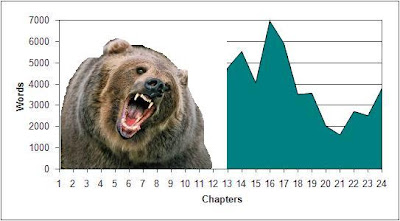

Here is a chart showing the chapter-by-chapter wordcounts of my novel "Killing Hamlet":

I cannot help noticing that the profiles are very different. The middle chapters of "Cocke & Bull" are quite long, where the chapters of "Killing Hamlet" are all about the same length with the exception of chapters 6 and 18. Those two chapters come at the end of the First and Fourth acts (I'm using a 5-act structure for this book).
Do I know what any of this really means, or can I glean anything useful from it as a writer? Not so much. But the charts look cool. I'm a big fan of Excel. Anyway, it's Friday and I got nothing for you. For me it's going to be a 3-day weekend. Hopefully I'll get some writing done. Tonight, Mighty Reader and I are meeting some friends for crepes and wine at a nice French restaurant. You?
And this is for Nevets:

Tuesday, August 31, 2010
A Map of the World
I have been working on the first draft of a novel for the last couple of months. If I really push, I'm pretty sure I can finish by the end of September. There is really only the final conflict to resolve and some subplots to tie up and a last image to leave in the mind's eye of the reader. I figure maybe 20,000 more words or a bit less even than that. This all means that I have written the bulk of the book, and I have the story down on paper and I can refer back to it whenever I want and that the ending should be pretty straightforward to write. Except that I can't, or I won't.
One of my rules for writing a first draft is that I don't read any of what I've written once it's written. That is to say, I just keep plowing forward through the story and don't stop to go back over what's already on the page if it's earlier in the story than the chapter I'm currently writing. Sometimes I allow myself to go back and look up factual data like a date or a place name or how to spell "Corambis" or whatever, but that's all. The primary purpose behind this self-imposed exile from the written parts of the story is to keep me from endlessly fussing and revising and not finishing the first draft at all because I'm spending all my time revising Chapter One.
Something I've always wanted as a tool for writing has been a sort of way to map out the whole novel, a chart or a map showing the entire story arc and all the plotlines that I can refer back to when necessary. Nabokov used notecards to outline and keep track of his story, and I am experimenting with notecards for the final part of my current novel, but you can't really lay 150 or more notecards out end-to-end and see what's going on in a book. I have been building this big structure by hand and I will never be able to see the whole of it all at once, because of course the only true and accurate map of a novel is the novel itself, and I don't have one of those minds that can hold the whole novel all at the same time. I can only "see" bits of my own novel, which is a baffling and frustrating and fascinating thing. Possibly that's tied to complexity, and if I were writing a more straightforward tale, I'd be able to imagine the whole story simultaneously. I don't know.
So here I am, writing the last 20,000 words of a novel when I don't remember the first 20,000 very well. I feel like I'm a man who has walked along a very long mural and I can only see about five feet of it in either direction and the bulk of it is hidden by fog or in shadows and my memory of it is inexact. Certainly I'll have to do some work in revisions to make sure that the story is consistent all the way through, and there is one scene that I think I'll cut entirely because I never developed that particular subplot so what happens there makes no sense at all.
How do you go about "visualizing" the whole of the story? How abstractly do you think about the main story arc? How do you keep track of where you are? Does anyone have a really cool system for charting the entire story (I am looking for a visual/graphic system where it's all displayed together, sort of like a Microsoft Project(tm) graph or a Venn diagram or a flowchart or something)? How do you keep notes, I guess, is what I'm asking.
One of my rules for writing a first draft is that I don't read any of what I've written once it's written. That is to say, I just keep plowing forward through the story and don't stop to go back over what's already on the page if it's earlier in the story than the chapter I'm currently writing. Sometimes I allow myself to go back and look up factual data like a date or a place name or how to spell "Corambis" or whatever, but that's all. The primary purpose behind this self-imposed exile from the written parts of the story is to keep me from endlessly fussing and revising and not finishing the first draft at all because I'm spending all my time revising Chapter One.
Something I've always wanted as a tool for writing has been a sort of way to map out the whole novel, a chart or a map showing the entire story arc and all the plotlines that I can refer back to when necessary. Nabokov used notecards to outline and keep track of his story, and I am experimenting with notecards for the final part of my current novel, but you can't really lay 150 or more notecards out end-to-end and see what's going on in a book. I have been building this big structure by hand and I will never be able to see the whole of it all at once, because of course the only true and accurate map of a novel is the novel itself, and I don't have one of those minds that can hold the whole novel all at the same time. I can only "see" bits of my own novel, which is a baffling and frustrating and fascinating thing. Possibly that's tied to complexity, and if I were writing a more straightforward tale, I'd be able to imagine the whole story simultaneously. I don't know.
So here I am, writing the last 20,000 words of a novel when I don't remember the first 20,000 very well. I feel like I'm a man who has walked along a very long mural and I can only see about five feet of it in either direction and the bulk of it is hidden by fog or in shadows and my memory of it is inexact. Certainly I'll have to do some work in revisions to make sure that the story is consistent all the way through, and there is one scene that I think I'll cut entirely because I never developed that particular subplot so what happens there makes no sense at all.
How do you go about "visualizing" the whole of the story? How abstractly do you think about the main story arc? How do you keep track of where you are? Does anyone have a really cool system for charting the entire story (I am looking for a visual/graphic system where it's all displayed together, sort of like a Microsoft Project(tm) graph or a Venn diagram or a flowchart or something)? How do you keep notes, I guess, is what I'm asking.
Subscribe to:
Posts (Atom)