Showing posts with label Writer Interviews. Show all posts

Tuesday, May 17, 2011

Maybe Romance is More Than You Thought

Today we're talking about the romance genre. Yes. Romance. Here on the lab! I'd like to welcome Liz Borino, author of Expectations, a novel from LazyDay Publishing. She has some really interesting insights about romance that I think you should read.

The Romance Genre

Contemporary Romance. Romance, Lazy Day? Really? This was my initial (internal) reaction when I asked my newly acquired publisher how they’d classify my debut novel, Expectations. I envisioned the category of literary fiction or just mainstream fiction in the vein of Michael Cunningham. When I thought of romance books, I thought of predictable plotlines and shirtless men on the covers. Don’t get me wrong, I like shirtless men with ripped abs and a happy trail as much as the next straight woman… What was I talking about? My books and the romance genre, right. I decided to do some research before I stomped my bratty writer’s foot and calmly discussed changing the genre with Lazy Day.

The Romance Writers of America define the overall romance genre as having two main elements, “A Central Love Story: The main plot centers around two individuals falling in love and struggling to make the relationship work. A writer can include as many subplots as he/she wants as long as the love story is the main focus of the novel. An Emotionally-Satisfying and Optimistic Ending: In a romance, the lovers who risk and struggle for each other and their relationship are rewarded with emotional justice and unconditional love.”

Well…yeah. Expectations and its sequel, What Money Can’t Buy, actually focus on two couples, Chris and Aiden and Matt and Carley. To say their relationships are put through trials would be an understatement. As for the optimistic ending, I believe that’s important you have as many dark themes as I do.

The Romance Genre allows for as many storylines as an author’s creativity can come up with. Looking around the RWA website, I became more and more impressed with not only the quality and variety of writing from the other authors within the genre, but the community. So now, with the impending release of What Money Can’t Buy, I’m proud to call myself a Contemporary Romance author. Now where’s my man with a six pack?

Hah! I love it, Liz! Thank you so much. I think that romance has such a stigma attached to it that many writers aren't willing to look past that stigma to see the possibilities behind that genre. I'm excited about your new book, Money Can't Buy Can't Buy!

Liz is with LazyDay, a small publisher I have talked about over on The Innocent Flower. 

So, Liz, how did you get signed with a small publisher?

I got tired of querying and getting form rejections, so I began exploring other options. As much as I liked the idea of the control of self-publishing, I felt Expectations should be put out by a publisher to give it more 'cred'. A few weeks after I made that decision, Lazy Day began following me on Twitter. From there, I queried and two months later was accepted.

Since you've been with a small publisher, do you have plans to move on eventually? Have you felt the need for an agent?

No, to the agent. If I made a move it would be to self publish. There wouldn't be so much uncertainty. Though, Lazy Day is wonderfully supportive and I don't plan to leave anytime soon, unless they get weary of my neurosis!

That's fantastic! I love my small publisher, too. It's no wonder many authors are going that route these days. Can you tell us a little bit about your first book with them?

Expectations blurb: Ourselves and our familial obligations. The struggle is personified by Chris and Matt Taylor, identical twins, who are trying to win their overbearing father’s approval and acquire their trust funds. Love, money, and desire collide as Matt and Chris decide what’s really important to them.

Can you tell us what's for you on the horizon after your second book release?

Oh wow, um, well I've already started the third book, and I'm building my PR business to help other authors and different kinds of artists promote themselves

That's great! Do you plan to keep writing in the romance genre?


Thanks! It seems my stories tend to have romantic themes to them and I intend to keep this series going as long as makes sense.

It does! Thank you so much, Liz, for guest blogging with us today. You can find Liz on her Author Site and on Facebook. Her second novel, What Money Can't Buy, will be up on Amazon soon for purchase. You can find Expecations here.

To WIN a free eBook of Expectations by Liz Borino, simply leave a comment here! We'll choose a winner and let them know by email that they've won. Thanks, everyone!

Friday, September 24, 2010

The Paris Review Interviews

In case you don't know, the Paris Review has been interviewing good writers (of fiction, poetry and nonfiction) for over half a century. They've put all of these interviews on the internets, here. Go read some of them; get inspired. Check out Hemingway's cranky boredom with George Plimpton. Imagine yourself answering the interviewers' questions.

Also! Starting tomorrow, it is Banned Books Week. Celebrate your freedom to read! Go expose yourself to something dangerous.

More and Better Also! If you live in glorious Seattle, make sure you swing by the University Bookstore (4326 University Way, N.E) by 7pm to hear Alexandra MacKenzie read from her debut novel Immortal Quest. You must come, and you must buy a copy, and Alex must sign it! Because I said so!

Monday, August 9, 2010

What if you forgot everything you ever wrote?


Meet Murray Dunlap. He's a writer. He wrote stories years ago, and he's still writing now. But, in between the then and the now, something happened. He got amnesia.

LL: First off, tell us about your situation and what happened to you. Feel free to be as brief or as detailed as you want.

MD: OK. on June 7th, 2008 (6-7-08 as creepy as that is), I was just driving down our street, taking some recycling in, when a stranger ran a red light and smashed into me. It was crazy. Pushed me right into some friends who were minding their own business driving in the next lane. The thing is, I can’t remember a thing. Weird as it seems, a very near death experience with zero memory. None. Literally, it may be the closest I’ve come to death, and try as I might, I've got nothing. Nothing.

And the following year was so horrible, there are no words. Just anger. And fear. My God, the fear. I was in a wheelchair when I came out of the coma, which I was in (coma) for three months, and never had any doctor convince me that it was 100% clear that I would walk again. They assured me I would walk. But I was nervous. They mumbled all sorts of things about my brain and legs not talking, but I always felt like there was a very real chance I would never walk again.

So day-by-day, I went to therapy and gave it my all. What else could I do? You would be surprised by the determination that comes over a person when walking is on the line. Therapy 5 days a week and I made up my own therapy on weekends. Sprinkle in doctors here and there, and then you’ve got yourself a recovery process. Damn, that gets old! I think it may be the closest I’ve come to insanity yet.

I’ve come awfully close to dying about a dozen times, but this, nothing compares to it. Most near death experiences are just like you would imagine: extremely dangerous, but for an instant. Compare just about anything to a coma for 3 months and that followed by a full year in a wheelchair, and that followed by 6 months using a walker, like an old man. It simply makes no comparison. Like the time I was run over by a motor boat, while intense, was over almost immediately. So then a trip to the ER and some stitches and, like most accidents, then it’s over.

Or when I jogging at college, and some professor’s daughter was coming around the corner too fast, and not looking. So I was put on the hood with both hands pressed flat against the windshield. And was close enough to see her face, and despite my hopes, knew she would slam on brakes from the look in her eyes. So I went flying off the hood and went flying into the street until gravity tore me down and I landed, on my left knee, in the same very hard street. Campus security swarmed me, either out of concern for my safety or concern for my lawsuit-capable parents. I’d day the latter is more likely.

So I guess you could say I’ve been lucky. Or it’s just as easy to say I’ve been awfully unlucky depending on your point of view. I'm not dead yet...

LL: I should mention to everyone that the reason I met you was because the literary journal I work for, SmokeLong Quarterly, accepted a story that you had written before the accident. What is it like to look at your own work without having any memory of writing it?

MD: Very weird. Very. It is as if I have pulled a rabbit out of a hat and not known where the rabbit came from. Truly. That weird. And it is as if I am reading it for the first time. I have a fuzzy feeling I know what is about to happen, but then I'll get confused. I'm on lots of medicine!

LL: How has your writing changed because of what happened?

MD: I don't think about anything the same way. Nothing. I have much less sympathy for problems that have no real danger at all. When I have a character I hate, I simply have to have them complain about anything stupid. Anything. It makes my skin crawl to hear people say how "rough" they have it when it makes an instant comparison to being in a wheelchair. Even if they don't realize they have done it. But for my writing, I think little things, like love and care, are more important to me than ever. Ever. I could have shoved a billion dollars at anyone after the wreck and they could not have made me walk... So. Money is meaningless to me now. But I think in writing, it makes me more attuned to characters showing love for one another. Love is MUCH more important to me than ever before.

(You can read two of Murray's stories, here. The Dogs Go Too was written before his accident. Times I Nearly Died was written after.)

LL: To come back to writing after the amnesia implies that you've dedicated yourself to this art form twice. Is that true? Was there any possibility of you NOT being a writer after the accident?

MD: Yes. I was so dissoriented and medicated that, literally, I am just now feeling like I can try again! Weird to focus on something for so long and then be forced to take just under 3 years off...

But it's getting better. And my memory is improving enough that I can remember at the end of a sentence what the beginning was about... It was that bad.

LL: Do you you think there is a universal consensus (or should there be) about what is dramatic or important to write about versus what isn't? I think a lot of writers would argue that the subject of the story isn't as important as the way that subject is written about. Do you disagree?

MD: I think every writer has to share the way he or she sees things. Whatever way that may be. I think I agree that the subject is less important than the way the story is told. If it wasn't, there would be nothing but horror movies. But what we've all learned is that yes, it can be interesting to see or read about a person in danger of losing their life, but in the end, it is the life itself and the connections made that truly reveal something.

LL: Do we as writers have a job to do, a common goal, as you see it?

MD: Yes. What writers do is complete our understanding of life itself. That and give people an emotional ride that they might not get otherwise. And to see themselves expressed through words that help life make sense. I'm starting to sound very pretentious I think, but really, I would like to think "our" job here is that important. Sort of a psychologist for the species.

LL: Do you have any additional insight from your experience that other writers might find useful?

MD: I guess anytime a writer thinks a character is "in it", they should take a glance at the handicapped or insane and realize just how bad things really can get. Maybe spend a day without walking, if they can?

LL: And, what projects are you working on now?

MD: I've been working very hard with Kevin Watson of Press 53 on an anthology that we've named "What Doesn't Kill You...". Should be wonderful! Our book launch will be at the Southern Festival of Books in Nashville, TN on October 9. It has been a lifesaver to have a job to do when I have been unable to drive to a job (or anywhere) and have become bored to tears. But I will say that what didn't kill me made me a better writer.
__

Murray, thanks so much for telling us about your amazing story!

Thursday, August 5, 2010

You Need to Read This Book!

A review and interview with Andrew Blackman about his award-winning novel, On the Holloway Road

I don't do book reviews here often. In fact, I'm not sure I've done any book reviews here. Which is a complete shame because there are so many out there, and I've read a few of them, and I'd like to share those with you. Today, however, we'll focus on one.

"Andrew Blackman's debut novel On the Holloway Road (Legend Press, February 2009) won the Luke Bitmead Writers' Bursary and was shortlisted for the Dundee International Book Prize. It tells the story of two young Londoners who, inspired by Jack Kerouac's Beat classic On the Road, embark on a similar search for meaning and freedom in modern-day Britain."

Soon after I met Andrew Blackman in the blogosphere, I planned to read his novel. It took me well over a year to finally buy it and read it. I'm lame, yeah. But I'm glad I got to it! This book is a gorgeously written, literary narrative that brought tears to my eyes on more than one occasion. Especially the end. At first I thought I would hate one of the main characters, Neil:

Compared to my own sad, shambling existence in the shadows of life, his was a kaleidoscope. I peeped from behind my mother’s curtains at the world outside and wrote about people like Neil. I never believed that he really existed until I met him.

Blackman brought to life a world I've never known: that of two young men, one completely reckless and full of life, the other so stiff you could snap him half, rambling about the English countryside getting into trouble, sleeping with girls, and pretty much breaking any rule they can find. As soon as I thought I'd figured out the novel, thinking it was all about Neil and his crazy existence, Blackman pulled back the fine layers of his story to reveal something much deeper and poignant. All of a sudden his main protagonist, Jack, came to the forefront. Everything about him I could relate to: his feelings of failure, his struggle to feel alive in an increasingly stiffling world, his constant comparing himself to others. This connection I felt to Jack took me back to my high school years, my college years, and then reminded me that I still deal with these feelings now. By the end of the novel Jack helped me view things from a different angle.

Blackman's prose is rich and flawless. His descriptions brought the story to life, each one like a rolling wave, constant and sure. On the Holloway Road combines this lovely prose with strong characters and a gripping plot, creating a novel you shouldn't miss.


INTERVIEW

MDA: First, I'd like to let you know how much I enjoyed your novel, On The Holloway Road. Can you tell us a little bit about the book and when you started writing in general?

Andrew: I'd always wanted to be a writer, but never really believed I could do it. So although I wrote bits and pieces in my spare time, I didn't really take it seriously. Instead I got a 'sensible', well-paid job as a corporate banker, first in London and then New York, and then for three years I worked as a staff reporter for the Wall Street Journal. I was writing and getting paid for it, yes, but I was still being 'sensible' and only taking a half-step towards doing what I wanted. I found myself getting up at 5:30am to write my own stuff before going to work, where I wrote other people's stories.

So in 2006 I moved back to London and for the first time really focused on writing fiction. I found temp jobs at nights and weekends to pay the bills, and during the days I wrote. I finished a novel, sent it off to agents and publishers, and accumulated a large manila folder full of polite but firm rejection letters. I revised it, sent it out, and got more polite but firm letters to add to my manila folder. In November 2007, for a break, I entered the National Novel Writing Month challenge to finish a novel in a month. I started on a completely new idea, something about a couple of young guys in London who set out to emulate Jack Kerouac's famous road trip in England, but discover that it's not as easy to be free and spontaneous in 2008 Britain as it was in 1950s America.

The result was On the Holloway Road. Of course I edited it later, but not very much - the basic manuscript was done in a month, and it was a lot better than the other novel that I'd spent years working on. For the first time I was writing for myself, not an imagined audience, and it worked really well for me. After a few months I entered On the Holloway Road for the 2008 Luke Bitmead Writers Bursary, a prize for unpublished authors. The prize was £2,500 and a publishing contract with Legend Press, and to my amazement I won. The book came out in February 2009 and has done well - it was shortlisted for the Dundee International Book Prize, and picked up a few decent reviews.


MDA: Wow! You've had such great success so far! Can you tell us if you'll be publishing any more books with Legend Press? Do you have an agent?

Andrew: Yes, I do have an agent, James Wills of Watson Little. He has been great in reading the drafts of my next novel and making suggestions for improvements. Right now I'm concentrating on getting it finished, and will let James advise me on the best thing to do next. I've been really happy with Legend Press and how they handled On the Holloway Road. They are not a very big publisher, but managed to get my book stocked in all the main bookshops in the UK, and have arranged lots of events for me to help get the word out. So I'd be happy to work with them on future books, but nothing's fixed right now.


MDA: That's fantastic you have such a great agent and press! I'm truly jealous because I love the idea of going small and still being recognized as you have. Amazon recently reported that ebooks are selling more than paper books. How do you feel about that? I already know you're a fan of the small press, but how do you feel about self-publishing and the ebook rise?


Andrew: To be honest I'm a little old-fashioned - I love paper books, and it's always been my dream to have a house large enough to have a room of my own with bookshelves from floor to ceiling around all four walls (right now they're in big piles all around the flat!). When I had On the Holloway Road published, Legend Press emailed me lots of pdfs to proof during the editing process, but the excitement when I received the first physical copy was completely different. As I held it in my hands, ran my fingers over it, saw my name on the cover and flicked through the pages, I felt for the first time that I had realised my dream. Personally I'd hate for paper books to disappear.

I also worry that the way we read will change, as the nature of electronic media is very different from paper. As more features are added to ebooks, they could become more like the internet - full of links to other books or websites, less linear and more associative. Of course there's a lot to be said for that, but I do like the way that right now you can read a book from beginning to end without distractions, and I worry that even the way we think could change quite radically in a very short time. Perhaps the changes are for the better, but I don't think we've really thought through all the implications.

I'm a lot more positive about self-publishing. To me it's great that so many people can now publish so easily and cheaply - it's very democratic, and is one of the things that technology is so good for. I never considered self-publishing for myself, because I am very bad at marketing and publicity, and have no interest in doing it - I prefer to write. With the traditional publishing model, the publisher takes a large percentage of the profits, but the advantage is that they get your book into the shops, they promote it, they use their media contacts to get reviews and profile articles published, etc. With self-publishing you're entirely on your own and have to do a lot of work to generate every sale. It's not for me, but it works for a lot of people and I think it's a very positive development.


MDA: For our last question I'd like to ask you what the one thing is that you want from being a writer. Is it fame? Sharing your work? Creating something beyond yourself and growing? I could go on and on.


Andrew: I've always been quite a shy person, and I often feel that in conversation I don't express myself very well. When I first discovered writing, back in my childhood, I loved the fact that I could take my time and get it right. There was no need to just blurt out whatever came into my head and then regret it later; I could think about what I really wanted to say and put that down on the page. I think today it's still more or less the same impulse. It's having ideas buzzing around in my head but finding that when I open my mouth they come out all garbled. Writing gives me the space and time to work through those ideas and express them in the clearest possible way.


MDA: It's scary how much I relate to your last answer! Thank you for taking the time for this interview! Where can we get your book, and do you know when your next will be out?

Andrew: No problem, thanks for reading the book and coming up with some good questions! The best way to buy On the Holloway Road if you're outside the UK is to go to the Book Depository, where they now offer free worldwide shipping. Alternatively you could go to Amazon UK, or Amazon US to get the Kindle edition or buy from a 3rd-party seller. The eBook is sold through UK bookshop Waterstones, and finally if you want a signed copy just email me and send me enough to cover the cost of the book and shipping to wherever you are. Or if you're in the UK, you could always go to a real, physical bookshop and pick it up from the shelf!

The next one will probably not be out until next spring or summer at the earliest, and that's assuming that I finish soon and that my agent loves it and says it doesn't need any more rewriting. Both quite optimistic assumptions, but I think writers have to be optimists :-)


Monday, May 10, 2010

Do Used Bookstores Hurt Writers? An Interview with Josh Spencer

I had the pleasure of visiting The Last Bookstore, a new used bookstore in downtown L.A. Not only did TLB carry a bunch of titles I rarely see in other bookstores, but it also hosted a local poetry reading that included the sale of dozens of self-published chapbooks. The owner of TLB is the young and very low-key Josh Spencer, and he was kind enough to answer a few questions for The Literary Lab.


LL: Tell us about yourself and about The Last Bookstore. (For example, how and when did you decide you wanted to open up your own bookstore? Do you only carry used books? Do you carry small press books or self-published books?)


JS: Well, I've sold books online for over a decade. For a few years I've had the crazy idea of opening an actual physical storefront to buy and sell used books as well, as an addition to my online business. Late in 2009, a space in my neighborhood opened up and I jumped on it. The landlord gave us only 10 days to open up, so my dad flew out from Hawaii and hand-built all our shelves in just 3 days! We worked ourselves to the bone getting everything set up and books on the shelves in time for the landlord's requested opening date, which coincided with the monthly Art Walk we have in downtown LA which draws over 10,000 people.


We generally only carry used books, but I'd say 75% of our inventory is in like new condition. We've carried a couple of new self-published titles and poetry chapbooks by local downtown LA writers, but for now used books are our focus. We also buy and sell used DVDs and CDs, and we carry over 100 new magazines on art, architecture, design, music, fashion, and the like.


The latter is sort of an experiment to see if we can sell any, and so far it's looking like we may drop the new magazines in favor of more used books.


LL: You've made your space available to help other writers. Can you tell us about some of these events?


JS: I actually leave all our events up to Billy Mark, a poet and musician and our events coordinator. He could tell you better than I could. I'm a bit "event-shy" myself because I don't like crowds and small talk. But I know we just had a book release by local poet Chiwan Choi which had a packed house, and he also runs a Poetry Chapbook reading and discussion every 3rd Sunday from 3-5 pm. A few weeks ago we had a reading by Jim Marquez, literary editor of Citizen LA and self-publisher of several books. Every Thursday except for the 2nd Thursday of the month, we have Literally Funny -- live readings of comedy pieces. It's pretty popular. On May 23rd, we're having an "Essays on Downtown LA" night with members of Los Angeles' downtown 3-on-3 basketball league. I think those are guys that live in the homeless shelters, so that should be pretty interesting. Then we also have live music nights and some other events. We're pretty open to hosting any community event that we like and that brings in book-buyers!


LL: Are there other ways in which you're helping writers?


JS: Hmm, not that I can think of. We love writers, obviously, and some of our events are geared to them, but as a used bookstore we're mainly focused on serving readers and collectors of books in their habit.


LL: What can we as writers do to help support bookstores?


JS: Keep writing books that people actually want and need to read!


LL: Among writers, the sale of used books is often discouraged because the writers rarely benefit financially from the sale of their books in used condition. Do you feel like you're hurting writers in any way?


JS: Really? I'm a writer and a ton of my friends are writers, and I've never heard that sentiment towards used books. That's interesting. But I feel like a single used bookstore hurts current writers about as much as a bee sting. The advantage of a used bookstore versus a new bookstore is VARIETY. We don't sell 100 copies each of a few dozen titles like most new bookstores; we sell one or two copies of 10,000 different titles by different authors dead and alive. I can't think of a single title we've had and sold more than a dozen copies of, and our best-sellers are usually by dead authors anyway. So it doesn't really affect current writers in any real way that I can see. Besides, most new titles don't trickle into used bookstores until 6 months to a year after they're out and by that time they've usually already had the majority of their sales, with the exception being sleepers and self-published titles.


A lot of people who shop in our store wouldn't be able to afford many new books, or they prefer older books, or they like used books because they can get 3 for the price of 1 new book. But then there are really rabid readers who are going to buy what they want to read when they want to read it, whether it's new or used. They have a hunger for books like vampires do for blood! Although the act of buying books lacks much in the way of sex and violence, unfortunately.


Ultimately I think the more people who are reading in a community or society, the better that is for writers. Whether people are buying used or new, or borrowing from a friend or the library, all efforts that feed the enjoyment of the written word are beneficial.

Friday, February 19, 2010

We've Been Interviewed!

Davin and Michelle have been interviewed by Victoria Mixon, a professional editor. Victoria wanted to discuss the Literary Lab's experience using the print-on-demand services of lulu.com to publish the Genre Wars anthology. You can read the interview here. Go, read!

In other news, life has been horrifically busy for some of us (that'd be me) and so I have no actual post today. I promise to do better next week, honest. One fun thing I did this week was have a couple of pints with author Layne Maheu (his book Song of the Crow is one of the reasons we now share an agent, because I love the book and had to know who repped it) at the fabulous West 5 in Seattle. We talked about how similar our experiences with our mutual agent have been, what new stuff we're working on (Layne's new book sounds amazing and I hope it gets sold soon so I can read it), our shared dislike of writing about modern times (as Layne put it, "You can get more pure colors when you move the story into the past, because you can see things more clearly at this distance") and a bunch of other stuff that's likely only interesting to Seattle residents. I don't know how he falls on the viaduct/tunnel question. Nor did we talk baseball, so I don't know where he is regarding the DH. Anyway, if you have a chance to hang out in real life with other writers, go do it. The internets is a fun space, but it's just not as much fun as making story maps using pint glasses, table tents and coasters. Really, it's not.

That's all I've got today. Have a swell weekend, everybody.

Friday, December 11, 2009

Author Interview: Alexandra MacKenzie

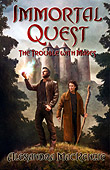
Tell us about yourself and about your forthcoming book, "Immortal Quest: The Trouble with Mages."

The novel is a serio-comic fantasy “buddy” adventure set in contemporary Britain. Detective Nick Watson is ordered to spy on a mysterious thief named Marlen who claims to be a 500-year-old mage – and who also believes Nick is his long-lost amnesiac best friend who will help him save the world from a power-crazed immortal. They’re all on the track of three ritual objects needed for a world-shattering spell. Hijinks ensue (the comic part). The more serious part is about memory, friendship, and the extent to which memories constitute personality.

"Immortal Quest" had a long road to publication and only found a publisher after you'd declared that you'd given up writing. Tell us the story of finding Edge (or of Edge finding you).

I’m always declaring that I’m giving up writing. I do it every six months or so. Writing is hard. On the other hand, I love having written. So I don’t give that up. I wrote the first draft 15 years ago after completing the Clarion West writing workshop, and sent it to Baen Books, who kept the MS for a year and a half. I got a call from an editor there who wanted it, but she couldn’t push it past the publisher. Huge disappointment (I gave up writing). I sent it to every other SF/Fantasy house in the U.S. for which you didn’t need an agent. Plus I queried agents. A number of editors sent personal rejection letters, which are always encouraging, and one at Tor suggested another house as a better fit, which was kind. Nearly always it sat for six months or more at a house before a decision would arrive. I moved on to other things. I gave up writing several times. Then a local press offered on it, which got me very excited, until I discovered that they wanted to produce books only on CD (the “wave of book publishing’s future” they said). After further investigation, I worried they didn’t know what they were doing, and after I asked them a number of pointed questions, they retracted the offer. They’re no longer in business. I gave up writing and got a Certificate in Scientific Illustration from the University of Washington and focused on art instead.

Then one day more recently I was idly surfing the Web for fantasy publishing places for a story I’d written, and ran across Edge Science Fiction and Fantasy Publishing based in Calgary. I liked the look of their books. I thought, “Huh, I’ve never tried Canadian houses. Why haven’t I done that?” Possibly not the best research technique in the world, but they liked the novel. And they bought it. Which was almost anticlimactic after all that time, as I’d moved on and had plenty of other things on my plate.

You don't have an agent, and queried publishers directly. That seems to be more common in SF/F than in other genres. Any plans to find an agent and try to sell “Seattle Sleuth”, your unpublished detective novel?

I doubt it. Truth to tell, I didn’t try hard enough to find an agent – I only got through the agent listings from A to L before giving up. I did query agents about the mystery novel – no dice. Genre does seem more open to “over the transom” submissions. My writing is difficult to pigeonhole, and even I have trouble figuring out how someone would market it. But you never know – the right person could be out there and we just haven’t met yet.

The most frustrating part of the whole game is making that perfect connection. It’s incredibly frustrating to get back rejections that make no sense – for the mystery novel, which is set in 1921 Seattle, I got one letter saying, “the language is too old-fashioned” and another letter which said, “the language is too modern.” What is a writer supposed to make of that? What I make of most such comments is not “Your writing sucks”, but rather, “You simply haven’t made the right connection with the person who understands what you’re doing.”

You just finished up a sort of "lightning-round" of revisions for your editor at Edge. How do you feel about that?

It was a good experience. She was kind and thoughtful and had clearly put a lot of work into her review of the MS. The revision suggestions were reasonable and she not only told me what she wanted, but why, and we had a lengthy phone call in which she took pains to ask what I thought about the major suggestions. Which thankfully were not that major – it was more about strengthening what was there rather than making big changes. I did have to write some new scenes but they were very short ones, and I worked on beefing up secondary characters. I felt rusty at first but once I got into it a bit and got the first few changes done, I began to feel more comfortable and things went more smoothly. It actually felt good to revisit old territory. I’m glad I had been “away” from the MS for a long time and could come at it fresh.

What sort of things did your editor talk to you about?

What I liked best about this editor’s approach was the concreteness of her suggested changes. She didn’t just say, “you need to build more tension between these two characters” but gave me specifics. “On page 116 in the dinner scene you could make the conversation between Nick and Marlen much more awkward.” At the end of our phone call I had four pages of handwritten notes with a lot of page numbers and scene references, and I was able to pretty much sit down and work my way through them one by one, checking them off as I went along. I’m a very methodical person by nature so this worked extremely well.

I did have one surprise during the phone call – the editor asked for an explanation for something in my world-building that had never occurred to me, and I didn’t know the answer. That gave me pause for a good 24 hours until the answer popped into my head in the middle of the night, as these things often do. Like most writers, I keep the requisite notepad and pen on the nightstand.

Did you learn anything from these revisions that you want to share?

What I learned: 1. No matter how much of the story you think you’ve told your readers, you are likely making assumptions in your head that don’t always get transferred to the page. 2. Be specific. 3. Build tension wherever you can. Tension stirs the reader’s interest. 4. Be willing to entertain new ideas. 5. Don’t make things too easy on your characters, even if it’s a comedy.

You're also an illustrator. Want to talk about "In My Nature?"

“In My Nature: A Birder’s Year at the Montlake Fill” by Constance Sidles is a book for which I produced 29 watercolor, pen-and-ink, and colored pencil illustrations (www.constancypress.com). The project was the result of sheer serendipity. Now, this is where my tale gets interesting. I’ve loved art and writing all of my life, bouncing between them, never focusing on one over the other, doing pretty decent work in both but nothing spectacular (or financially rewarding!). I always thought art and writing were my passions – as in those pop-psych career-finding books with titles like “Find your bliss and money will flow” of which I admit to reading a few. I just couldn’t figure out how to turn my passions into a career. Thus the day job, which supported my creative habits.

Then in May of 2008 I took up birding. I was looking for a new hobby which would also provide some low-key exercise to help with recovery from an accident. I liked birds, I liked being outside, so I took a class in Beginning Birding from Seattle Audubon, and then went on a field trip. And had an epiphanic experience of massive proportions. All those decades when I thought art and writing were passions, I was dead wrong. They were mere hobbies in comparison. Birding was my real passion, and man, do I wish I’d discovered it when I was a whole lot younger. I’ve never felt this way about anything (or anyone) ever. I had no idea something could have such a huge effect at my age (I’ll just say “very middle-aged”), but birding absolutely changed my life. At a low estimate, I’ve logged over 300 hours in the field since May 2008. I’ve seen over 200 species, traveled over 8,000 miles by train, car, and ship in pursuit of birds, taken dozens of classes and field trips, and read dozens of bird-related books, and discovered a whole new community of like-minded fanatics. It’s been amazing.

And just as those silly pop-psych books claimed, once I followed my true passion, things began happening and then some, which amuses me no end. I forgot all about writing. I forgot about art. All I cared about were the birds. Then in August 2008 I noticed there weren’t as many birds out and about. I’d found a “local patch” called the Montlake Fill and made friends with a woman named Connie Sidles who birded there nearly every day, and she said things often slowed down in summer. So on a whim, I brought my sketchbook next time, and she saw what I was doing, and liked what she saw. Turned out she was writing a book of nature essays about the place. The next thing you know, I was busy painting illustrations for her book. A little over a year later the book was published and I have an illustrator credit on the cover. Then in Summer of this year Edge SF accepted my fantasy novel, which is due out in Spring of 2010. The nice thing about all of this is that while I am genuinely pleased and excited by the projects, I am also feeling very relaxed, not just about these projects, but about any future ones that may crop up. If more things happen, fine. If they don’t, also fine. Because I will still have the birds, and that’s all that truly matters. Birds make me happy in a way that nothing else does.

What’s next for you?

Apparently, anything and everything. I’ve rarely been interested in short stories, but I managed to write a few back in the late 1980s/early 1990s that were bought by VERY small mags (SF market), and then wrote one in 2008 which was bought by online SF market Abyss & Apex (“Walking Across the Bomb”). The editor there has expressed interest in another story (which is related to birding!) but I’d first need to whack it in half. It’s currently 9,000 words – did I mention I don’t like to write short?

Connie is working on a sequel to “In My Nature” and would like more illustrations, so I’ll be working on that. The paintings for the first book took about eight months (I’m still burdened with my 40-hour/week day job). I’m sure the Edge editor will be back soon with more revisions (hopefully slighter ones at this point). I’ve been doing “In My Nature” book launch events. I have an idea and notes for a sequel to “Immortal Quest”, despite having given up writing. Truth to tell, the whole “giving up” ploy is a psychological trick to take the pressure off. Some authors are compelled to write. I’m not. Some authors are born story-tellers who can’t imagine doing anything else. Not me. It’s a hobby. I put as exactly as much effort into it as I want to and no more. So I haven’t really “quit” writing – I’ve merely reassigned it to a different section of my brain than it once resided. It once lived, mostly during my 20s and 30s, in a section marked VERY IMPORTANT! MUST WORK HARD AT THIS! MUST SUCCEED! EGO IS AT STAKE HERE!

Now it lives in a quiet cul-de-sac with a wee sign on an open wooden gate reading “hey, come on in, stay as long as you like, leave whenever you want.” And I do.

I am very impressed by writers who can do the hard work, the ones for whom writing is indeed their primary passion. People who write every day, authors who struggle to make a living without a day job, folks who are born story-tellers. I admire them greatly, I consider them to be the real writers, and have simply come to recognize that I am not one of them. They deserve all the success they can get, and I am happy to have my one novel in 15 years!

Though of course, you never know what might happen next. The gate is always open.

Alexandra MacKenzie's book "Immortal Quest: The Trouble With Mages" is due from Edge Science Fiction and Fantasy Publishing in Spring of 2010.

Monday, June 8, 2009

Writerly Advice from Mary Yukari Waters


I recently had a chance to have lunch and attend a reading with Mary Yukari Waters, a past teacher of mine that I have mentioned more than once on this blog. Mary’s short stories have been included in The Best American Short Stories, The Pushcart Book of Short Stories: The Best Short Stories from a Quarter-Century of the Pushcart Prize, and Prize Stories: The O. Henry Awards. She has received a grant from the National Endowment for the Arts and has also been supported by the Corporation of Yaddo, the MacDowell Colony, and Hedgebrook. Her debut novel The Favorites is currently available.


DM: Mary, thanks for offering to answer some questions for us!

In your first collection of short stories, The Laws of Evening, you thank Tom Filer and his Goat Alley workshop for guiding your writing. Who was Tom and why was he such a help to you?


MYW: Tom ran, and still runs, a workshop out of his home. The workshop is a combination of regulars, who have been coming for ten or twenty years, and new blood. I attended Tom’s workshops for a good many years before I got published, and the most special thing about them was that they didn’t focus on publishing, but on the old-fashioned artistic spirit – something of an anomaly in this age of MFAs and conferences and networking. Tom used to read us bits from the letters of Tolstoy and Van Gogh and others, or Faulkner’s Nobel Prize Acceptance Speech, or a host of other excerpts that he cut and pasted into an enormous scrapbook. I can still remember how it felt to drive home after those sessions, feeling excited and uplifted and reverent.


DM: Your new novel is The Favorites. What would you like our readers to know about it, or about your writing in general?


The Favorites takes place in Japan in the 1970’s and 80’s. It’s about an interfamily adoption in which a woman has to give up one of her babies to her sister-in-law. According to custom, the adoption is kept secret from the child until she comes of age. What complicates this situation is that both of these women live right on the same lane, and their children grow up together. The novel follows this family as these dynamics play out over the succeeding generations.


DM: This book deals with the complexities of Japanese social behavior as a young woman, Sarah Rexford, learns that she must think several steps ahead about her daily actions or risk offending her relatives. What is the purpose of a literary work for you? How important is the educational aspect of your story, or of a book in general? Do you view the explanations of Japanese life as a consequence of what you were trying to say, or was it part of your main message?


MYW: I was never a huge fan of lit classes in college. It seemed to me that they discussed everything but the heart of a story: what the dead rose or the stormy weather symbolized, what the author’s message was, what the theme was, what was going on historically and sociologically and politically when the work was written, etc. One great upside of being a writer is that you don’t have to do that kind of analysis on your own work. I think that creative writing requires you to rely less on left-brain analysis and more on what is subliminal. In other words, you steer by a gut instinct for what “matters,” even though you may not fully understand, at the time, how it works on a conscious level. So to answer your question, I can’t say I have any specific purpose, or message, other than the very basic one of wanting to share a story that I find interesting and moving, and hoping that the reader will feel the same way. The bits about Japanese life are there because I thought they would help the reader better understand the world in which the characters live.


DM: Many writers are working on their first novels or are trying to find an agent to represent their first novels. Can you tell us about how you came to be a client of agent Joy Harris? What qualities should a writer look for in an agent?


MYW: I was lucky in that it was pretty simple. A very kind teacher of mine, who was also a client of Joy’s, thought we might be a good fit. She suggested that I send her a query letter and a manuscript, so I did.

My sense is that the agent you get will probably be determined more by the quality of your manuscript than by any special strategy or personal connections. Believe it or not, this aspect of publishing is still pretty democratic. Someone once compared it to the Field of Dreams: if your work is sellable, then the agents will come. If you’re fortunate enough to have several reputable, competent agents from which to choose, then I would apply the general gut-test. Which one feels most likeable, trustworthy, considerate? Around which one do you feel the most relaxed? And, most importantly, which one really loves your writing?


DM: You also teach writing, and I know from personal experience that you do an excellent job at it. In working with so many beginning and intermediate writers, what are some common problems you encounter, and how can they be fixed?


MYW: Oh gosh, that would take an entire class – which, incidentally, was the class I was teaching when we met! I’ll make one general suggestion, though, and that would be to write about something that matters very deeply to you, that evokes powerful, even uncomfortable and painful, feelings within yourself. I’ve come across a lot of student stories that were well-written, had fine dialogue and fresh images, etc., but I haven’t always gotten the sense that the writers were deeply, personally invested in the stories they wrote. Maybe they wrote those stories because a deadline was coming up, or they wanted to experiment with point of view – and that’s fine. But my feeling is that one powerful, deeply felt story is worth ten competent, lukewarm ones. It’s true that you’ll pay a higher price for that one story; the creative process will be more emotionally intrusive, and you’ll make yourself more vulnerable to the reading public. But I greatly respect personal risk in a writer, and my feeling is that editors do so as well.


DM: Lastly, your work has appeared in some highly respected literary journals such as Zoetrope: All-Story, Glimmer Train Stories, and Triquarterly, as well as in very respected anthologies such as The Best American Short Stories. What, for you, are the key elements a piece of fiction must have before it will be accepted by these publications?


That’s a really great question. I think, though, that it’s sort of like asking what key elements a woman must have before a man will fall in love with her. One could come up with a list: beautiful face, intelligence, sense of humor, great body, etc. And these are all helpful elements to have. But ultimately, what makes a person fall in love is some unique, deeply personal quality that transcends such bread-and-butter qualifications. Similarly, an editor will pick a story not because it conforms to some preconceived list of requirements, but because he’s fallen in love with it – because it has some unique vision, some unique and deeply honest sensibility, that affects him on a personal level. One stumbling block for beginning writers is that they mistakenly hold back from being completely honest, completely themselves, because they think it’s safer to adopt styles and sensibilities that “editor types” will like.


Note: This interview first appeared on SmokeLong Quarterly.